NSJ Bioreagents
SKU:V9753-100UG
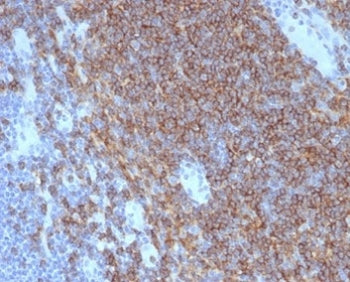
CD4 Antibody, 100 ug
CD4 Antibody, 100 ug
Couldn't load pickup availability
Recognizes a protein of 55kDa, identified as CD4. It is a membrane glycoprotein of T lymphocytes that interacts with major histocompatibility complex class II antigens and is also a receptor for the human immunodeficiency virus. This protein is expressed not only in T lymphocytes, but also in B cells, macrophages, and granulocytes. It is also expressed in specific regions of the brain. The protein functions to initiate or augment the early phase of T-cell activation, and may function as an important mediator of indirect neuronal damage in infectious and immune-mediated diseases of the central nervous system. Multiple alternatively spliced transcript variants encoding different isoforms have been identified.
Specifications
| Catalog No | V9753-100UG |
|---|---|
| Family | Primary antibody |
| Qty | 100 ug |
| Formulation | 0.2 mg/ml in 1X PBS with 0.1 mg/ml BSA (US sourced), 0.05% sodium azide |
| Format | Purified |
| Clone | CD4/7142 |
| Host Animal | Mouse |
| Clonality | Monoclonal (mouse origin) |
| Isotype | Mouse IgG2c, kappa |
| Species Reactivity | Human |
| Application | IHC-P |
| Application Details | Immunohistochemistry (FFPE): 1-2ug/ml |
| Application Note | Optimal dilution of the CD4 antibody should be determined by the researcher. |
| Localization | Cell surface |
| Immunogen | A portion of amino acids 200-400 was used as the immunogen for the CD4 antibody. |
| Purity | Protein A/G affinity |
| Storage | Aliquot the CD4 antibody and store frozen at -20oC or colder. Avoid repeated freeze-thaw cycles. |
| Limitation | This CD4 antibody is available for research use only. |
| Uniprot # | P01730 |
| Status | Available |
| PDF Link | https://www.nsjbio.com/tds-pdf/cd4-antibody-cd47142-v9753 |
| Title | CD4 Antibody |
| Description | Recognizes a protein of 55kDa, identified as CD4. It is a membrane glycoprotein of T lymphocytes that interacts with major histocompatibility complex class II antigens and is also a receptor for the human immunodeficiency virus. This protein is expressed not only in T lymphocytes, but also in B cells, macrophages, and granulocytes. It is also expressed in specific regions of the brain. The protein functions to initiate or augment the early phase of T-cell activation, and may function as an important mediator of indirect neuronal damage in infectious and immune-mediated diseases of the central nervous system. Multiple alternatively spliced transcript variants encoding different isoforms have been identified. |
Share