1
/
of
1
NSJ Bioreagents
SKU:V9702-100UG
MICA Antibody, 100 ug
MICA Antibody, 100 ug
Regular price
$559.00 USD
Regular price
Sale price
$559.00 USD
Unit price
/
per
Shipping calculated at checkout.
Couldn't load pickup availability
MICA and MICB are stress-induced antigens that are related to major histocompatibility complex (MHC) class I molecules. MICA and MICB are frequently expressed in epithelial tumors. These highly glycosylated cell surface proteins are stably expressed without conventional class I peptide ligands or association with γδ T cells expressing variable TCRs, suggesting that these antigens may play a central role in the signaling of cellular distress to evoke immune responses in the intestinal epithelium.
Specifications
| Catalog No | V9702-100UG |
|---|---|
| Family | Primary antibody |
| Qty | 100 ug |
| Formulation | 0.2 mg/ml in 1X PBS with 0.1 mg/ml BSA (US sourced), 0.05% sodium azide |
| Format | Purified |
| Clone | MICA/4442 |
| Host Animal | Mouse |
| Clonality | Monoclonal (mouse origin) |
| Isotype | Mouse IgG2b, kappa |
| Species Reactivity | Human |
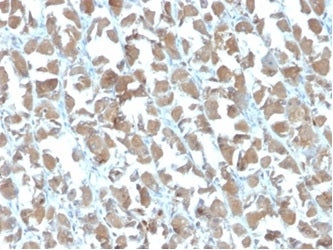
| Application | WB, IHC-P |
| Application Details | Western blot: 1-2ug/ml,Immunohistochemistry (FFPE): 1-2ug/ml |
| Application Note | Optimal dilution of the MICA antibody should be determined by the researcher. |
| Localization | Cell surface, Cytoplasm |
| Immunogen | A portion of amino acids 1-200 was used as the immunogen for the MICA antibody. |
| Purity | Protein A/G affinity |
| Storage | Aliquot the MICA antibody and store frozen at -20oC or colder. Avoid repeated freeze-thaw cycles. |
| Limitation | This MICA antibody is available for research use only. |
| Uniprot # | Q29983 |
| Status | Available |
| PDF Link | https://www.nsjbio.com/tds-pdf/mica-antibody-mica4442-v9702 |
| Title | MICA Antibody |
| Description | MICA and MICB are stress-induced antigens that are related to major histocompatibility complex (MHC) class I molecules. MICA and MICB are frequently expressed in epithelial tumors. These highly glycosylated cell surface proteins are stably expressed without conventional class I peptide ligands or association with γδ T cells expressing variable TCRs, suggesting that these antigens may play a central role in the signaling of cellular distress to evoke immune responses in the intestinal epithelium. |
Share