1
/
of
1
NSJ Bioreagents
SKU:V9531-100UG
GLIS3 Antibody / GLIS family zinc finger 3 / ZNF515, 100 ug
GLIS3 Antibody / GLIS family zinc finger 3 / ZNF515, 100 ug
Regular price
$559.00 USD
Regular price
Sale price
$559.00 USD
Unit price
/
per
Shipping calculated at checkout.
Couldn't load pickup availability
GLIS3 is a member of the GLI similar zinc finger protein family, and encodes a nuclear protein with five C2H2 type zinc finger domains. It functions as both an activator and repressor of transcription, and is specifically involved in the development of pancreatic beta cells, thyroid, eye, liver and kidney. Mutations in this gene have been associated with neonatal diabetes and congenital hypothyroidism (NDH). Alternatively spliced variants that encode different protein isoforms have been described but the full length nature of only two have been determined.
Specifications
| Catalog No | V9531-100UG |
|---|---|
| Family | Primary antibody |
| Qty | 100 ug |
| Formulation | 0.2 mg/ml in 1X PBS with 0.1 mg/ml BSA (US sourced), 0.05% sodium azide |
| Format | Purified |
| Clone | PCRP-GLIS3-1B11 |
| Host Animal | Mouse |
| Clonality | Monoclonal (mouse origin) |
| Isotype | Mouse IgG1, kappa |
| Species Reactivity | Human |
| Application | ELISA, FACS |
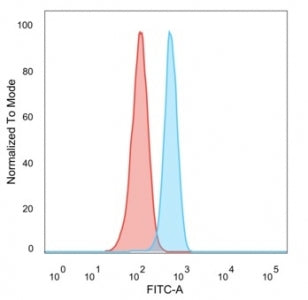
| Application Details | ELISA (order BSA-free format for coating),Flow cytometry: 1-2ug/million cells |
| Application Note | Optimal dilution of the GLIS3 antibody should be determined by the researcher. |
| Localization | Nucleus |
| Immunogen | Recombinant full-length human protein was used as the immunogen for the GLIS3 antibody. |
| Purity | Protein A/G affinity |
| Storage | Aliquot the GLIS3 antibody and store frozen at -20oC or colder. Avoid repeated freeze-thaw cycles. |
| Limitation | This GLIS3 antibody is available for research use only. |
| Uniprot # | Q8NEA6 |
| Status | Available |
| PDF Link | https://www.nsjbio.com/tds-pdf/glis3-antibody-glis-family-zinc-finger-3-znf515-pcrp-glis3-1b11-v9531 |
| Title | GLIS3 Antibody / GLIS family zinc finger 3 / ZNF515 |
| Description | GLIS3 is a member of the GLI similar zinc finger protein family, and encodes a nuclear protein with five C2H2 type zinc finger domains. It functions as both an activator and repressor of transcription, and is specifically involved in the development of pancreatic beta cells, thyroid, eye, liver and kidney. Mutations in this gene have been associated with neonatal diabetes and congenital hypothyroidism (NDH). Alternatively spliced variants that encode different protein isoforms have been described but the full length nature of only two have been determined. |
Share