NSJ Bioreagents
SKU:V9530-100UG
CTSD Antibody / Cathepsin D, 100 ug
CTSD Antibody / Cathepsin D, 100 ug
Couldn't load pickup availability
Cathepsin D is a ubiquitously expressed lysosomal aspartyl protease involved in the normal degradation of proteins. It is synthesized as an inactive 43kDa preprocathepsin D that is cleaved and glycosylated to form a 46kDa procathepsin D and then further cleaved to produce 28kDa and 15kDa subunits (heavy and light chains, respectively). Cathepsin D exhibits pepsin-like activity and plays a role in protein turnover and in the proteolytic activation of hormones and growth factors. Mutations in this gene play a causal role in neuronal ceroid lipofuscinosis-10 and may be involved in the pathogenesis of several other diseases, including breast cancer and possibly Alzheimers disease.
Specifications
| Catalog No | V9530-100UG |
|---|---|
| Family | Primary antibody |
| Qty | 100 ug |
| Formulation | 0.2 mg/ml in 1X PBS with 0.1 mg/ml BSA (US sourced), 0.05% sodium azide |
| Format | Purified |
| Clone | CTSD/4497 |
| Host Animal | Mouse |
| Clonality | Monoclonal (mouse origin) |
| Isotype | Mouse IgG1, kappa |
| Species Reactivity | Human |
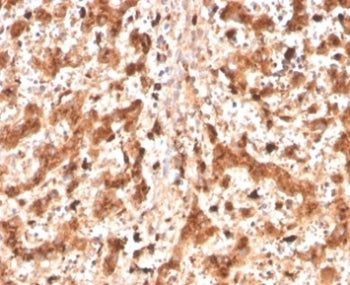
| Application | WB, IHC-P |
| Application Details | Western blot: 1-2ug/ml,Immunohistochemistry (FFPE): 1-2ug/ml |
| Application Note | Optimal dilution of the CTSD antibody should be determined by the researcher. |
| Localization | Cytoplasm |
| Immunogen | Purified His-tagged CTSD protein was used as the immunogen for the CTSD antibody. |
| Purity | Protein A/G affinity |
| Storage | Aliquot the CTSD antibody and store frozen at -20oC or colder. Avoid repeated freeze-thaw cycles. |
| Limitation | This CTSD antibody is available for research use only. |
| Uniprot # | P07339 |
| Status | Available |
| PDF Link | https://www.nsjbio.com/tds-pdf/ctsd-antibody-cathepsin-d-ctsd4497-v9530 |
| Title | CTSD Antibody / Cathepsin D |
| Description | Cathepsin D is a ubiquitously expressed lysosomal aspartyl protease involved in the normal degradation of proteins. It is synthesized as an inactive 43kDa preprocathepsin D that is cleaved and glycosylated to form a 46kDa procathepsin D and then further cleaved to produce 28kDa and 15kDa subunits (heavy and light chains, respectively). Cathepsin D exhibits pepsin-like activity and plays a role in protein turnover and in the proteolytic activation of hormones and growth factors. Mutations in this gene play a causal role in neuronal ceroid lipofuscinosis-10 and may be involved in the pathogenesis of several other diseases, including breast cancer and possibly Alzheimers disease. |
Share