NSJ Bioreagents
SKU:V9473SAF-100UG
FABP3 Antibody, 100 ug
FABP3 Antibody, 100 ug
Couldn't load pickup availability
The intracellular fatty acid-binding proteins (FABPs) belongs to a multigene family. FABPs are divided into at least three distinct types, namely the hepatic-, intestinal- and cardiac-type. They form 14-15 kDa proteins and are thought to participate in the uptake, intracellular metabolism and/or transport of long-chain fatty acids. They may also be responsible in the modulation of cell growth and proliferation. Fatty acid-binding protein 3 gene contains four exons and its function is to arrest growth of mammary epithelial cells. This gene is a candidate tumor suppressor gene for human breast cancer. Alternative splicing results in multiple transcript variants.
Specifications
| Catalog No | V9473SAF-100UG |
|---|---|
| Family | Primary antibody |
| Qty | 100 ug |
| Formulation | 1 mg/ml in 1X PBS; BSA free, sodium azide free |
| Format | Purified |
| Clone | FABP3/3430 |
| Host Animal | Mouse |
| Clonality | Monoclonal (mouse origin) |
| Isotype | Mouse IgG2b, kappa |
| Species Reactivity | Human |
| Application | IHC-P, WB |
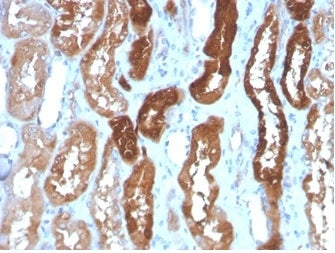
| Application Details | Immunohistochemistry (FFPE): 1-2ug/ml,Western blot: 2-4ug/ml |
| Application Note | Optimal dilution of the FABP3 antibody should be determined by the researcher. |
| Localization | Cytoplasm |
| Immunogen | A portin of amino acids 1-127 from the human protein was used as the immunogen for the FABP3 antibody. |
| Purity | Protein A/G affinity |
| Storage | Aliquot the FABP3 antibody and store frozen at -20oC or colder. Avoid repeated freeze-thaw cycles. |
| Limitation | This FABP3 antibody is available for research use only. |
| Uniprot # | P05413 |
| Status | Available |
| PDF Link | https://www.nsjbio.com/tds-pdf/fabp3-antibody-fabp33430-v9473 |
| Title | FABP3 Antibody |
| Description | The intracellular fatty acid-binding proteins (FABPs) belongs to a multigene family. FABPs are divided into at least three distinct types, namely the hepatic-, intestinal- and cardiac-type. They form 14-15 kDa proteins and are thought to participate in the uptake, intracellular metabolism and/or transport of long-chain fatty acids. They may also be responsible in the modulation of cell growth and proliferation. Fatty acid-binding protein 3 gene contains four exons and its function is to arrest growth of mammary epithelial cells. This gene is a candidate tumor suppressor gene for human breast cancer. Alternative splicing results in multiple transcript variants. |
Share