1
/
of
1
NSJ Bioreagents
SKU:V9381-100UG
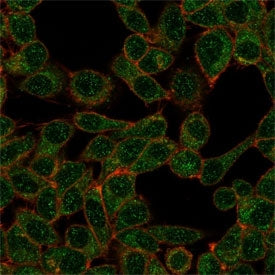
IRF9 Antibody / Interferon regulatory factor 9, 100 ug
IRF9 Antibody / Interferon regulatory factor 9, 100 ug
Regular price
$559.00 USD
Regular price
Sale price
$559.00 USD
Unit price
/
per
Shipping calculated at checkout.
Couldn't load pickup availability
Transcription regulatory factor that mediates signaling by type I IFNs (IFN-alpha and IFN-beta). Following type I IFN binding to cell surface receptors, Jak kinases (TYK2 and JAK1) are activated, leading to tyrosine phosphorylation of STAT1 and STAT2. The phosphorylated STATs dimerize, associate with IRF9/ISGF3G to form a complex termed ISGF3 transcription factor, that enters the nucleus. ISGF3 binds to the IFN stimulated response element (ISRE) to activate the transcription of interferon stimulated genes, which drive the cell in an antiviral state.
Specifications
| Catalog No | V9381-100UG |
|---|---|
| Family | Primary antibody |
| Qty | 100 ug |
| Formulation | 0.2 mg/ml in 1X PBS with 0.1 mg/ml BSA (US sourced), 0.05% sodium azide |
| Format | Purified |
| Clone | PCRP-IRF9-2F8 |
| Host Animal | Mouse |
| Clonality | Monoclonal (mouse origin) |
| Isotype | Mouse IgG2a |
| Species Reactivity | Human |
| Application | FACS, IF |
| Application Details | Flow cytometry: 1-2ug/million cells,Immunofluorescence: 1-2ug/ml |
| Application Note | Optimal dilution of the IRF9 antibody should be determined by the researcher. |
| Localization | Cytoplasm, Nucleus |
| Immunogen | Recombinant full-length human IRF9 protein was used as the immunogen for the IRF9 antibody. |
| Purity | Protein A/G affinity |
| Storage | Aliquot the IRF9 antibody and store frozen at -20oC or colder. Avoid repeated freeze-thaw cycles. |
| Limitation | This IRF9 antibody is available for research use only. |
| Uniprot # | Q00978 |
| Status | Available |
| PDF Link | https://www.nsjbio.com/tds-pdf/irf9-antibody-interferon-regulatory-factor-9-pcrp-irf9-2f8-v9381 |
| Title | IRF9 Antibody / Interferon regulatory factor 9 |
| Description | Transcription regulatory factor that mediates signaling by type I IFNs (IFN-alpha and IFN-beta). Following type I IFN binding to cell surface receptors, Jak kinases (TYK2 and JAK1) are activated, leading to tyrosine phosphorylation of STAT1 and STAT2. The phosphorylated STATs dimerize, associate with IRF9/ISGF3G to form a complex termed ISGF3 transcription factor, that enters the nucleus. ISGF3 binds to the IFN stimulated response element (ISRE) to activate the transcription of interferon stimulated genes, which drive the cell in an antiviral state. |
Share