1
/
of
1
NSJ Bioreagents
SKU:V9276-100UG
Recombinant FABP5 Antibody, 100 ug
Recombinant FABP5 Antibody, 100 ug
Regular price
$559.00 USD
Regular price
Sale price
$559.00 USD
Unit price
/
per
Shipping calculated at checkout.
Couldn't load pickup availability
The FABP5 gene encodes the fatty acid binding protein found in epidermal cells, and was first identified as being upregulated in psoriasis tissue. Additionally, FABP5 gene is upregulated in colorectal cancer cells compared to normal colon cells in a manner that correlates with disease stage and that FABP5 significantly promotes colorectal cancer cell growth and metastatic potential.
Specifications
| Catalog No | V9276-100UG |
|---|---|
| Family | Primary antibody |
| Qty | 100 ug |
| Formulation | 0.2 mg/ml in 1X PBS with 0.1 mg/ml BSA (US sourced), 0.05% sodium azide |
| Format | Purified |
| Clone | rFABP5/6354 |
| Host Animal | Mouse |
| Clonality | Recombinant Mouse Monoclonal |
| Isotype | Mouse IgG1, kappa |
| Species Reactivity | Human |
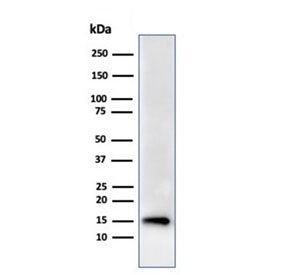
| Application | WB, IHC-P |
| Application Details | Western blot: 1-2ug/ml,Immunohistochemistry (FFPE): 1-2ug/ml |
| Application Note | Optimal dilution of the recombinant FABP5 antibody should be determined by the researcher. |
| Localization | Nuclear, Cytoplasmic |
| Immunogen | Recombinant human full-length FABP5 protein was used as the immunogen for the recombinant FABP5 antibody. |
| Purity | Protein A/G affinity |
| Storage | Aliquot the recombinant FABP5 antibody and store frozen at -20oC or colder. Avoid repeated freeze-thaw cycles. |
| Limitation | This recombinant FABP5 antibody is available for research use only. |
| Uniprot # | Q01469 |
| Status | Available |
| PDF Link | https://www.nsjbio.com/tds-pdf/recombinant-fabp5-antibody-rfabp56354-v9276 |
| Title | Recombinant FABP5 Antibody |
| Description | The FABP5 gene encodes the fatty acid binding protein found in epidermal cells, and was first identified as being upregulated in psoriasis tissue. Additionally, FABP5 gene is upregulated in colorectal cancer cells compared to normal colon cells in a manner that correlates with disease stage and that FABP5 significantly promotes colorectal cancer cell growth and metastatic potential. |
Share