NSJ Bioreagents
SKU:RZ1271
Zebrafish Psmd14 Antibody / 26S proteasome non-ATPase regulatory subunit 14, 100 ug
Zebrafish Psmd14 Antibody / 26S proteasome non-ATPase regulatory subunit 14, 100 ug
Couldn't load pickup availability
Psmd14 (Proteasome 26S subunit, non-ATPase 14) is a protein that is a part of the 26S proteasome complex, which is responsible for the degradation of ubiquitinated proteins. The 26S proteasome plays a crucial role in regulating cellular protein turnover, maintaining protein homeostasis, and regulating processes such as cell cycle progression, signal transduction, DNA repair, and gene expression. Psmd14, specifically, is involved in the regulation of proteasomal activity and is a key component of the regulatory particle of the proteasome.
In zebrafish, Psmd14 is an ortholog of the human PSMD14 gene. Both zebrafish and human Psmd14 share substantial sequence conservation, particularly in their role within the 26S proteasome complex, ensuring functional equivalence in protein degradation. This high degree of similarity makes zebrafish a valuable model organism for studying the molecular mechanisms of protein degradation and its impact on various cellular processes, including development, growth, and disease progression.
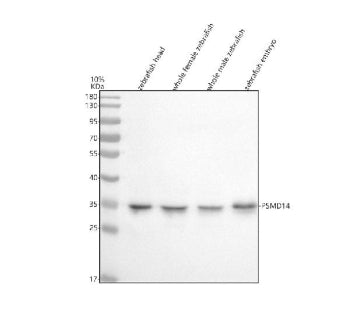
Psmd14 is expressed in a variety of tissues in zebrafish, including the brain, heart, and muscles, reflecting its importance in general cellular maintenance and metabolic processes. It has a critical role in regulating ubiquitin-mediated proteolysis, which is essential for cell cycle regulation, especially during embryonic development, cell differentiation, and tissue regeneration.
Zebrafish Psmd14 has isoforms, which may vary in their expression patterns and functional properties. These isoforms are likely to have tissue-specific roles, particularly in highly dynamic tissues such as neural and muscle tissue. The presence of isoforms suggests a degree of functional specialization and adaptability to specific cellular contexts, allowing Psmd14 to be involved in diverse aspects of protein homeostasis and stress responses.
Share