NSJ Bioreagents
SKU:RZ1251
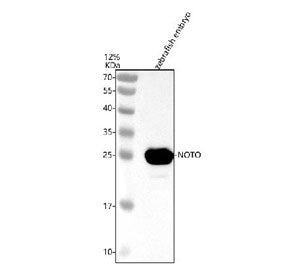
Zebrafish Noto Antibody / Notochord homeobox protein / Floating head, 100 ug
Zebrafish Noto Antibody / Notochord homeobox protein / Floating head, 100 ug
Couldn't load pickup availability
Noto, or notochord homeobox protein, is a transcription factor that plays a fundamental role in the formation and patterning of the notochord and tailbud during early embryonic development. In zebrafish, Noto is essential for proper axis formation, neural tube development, and left right asymmetry.
Zebrafish Noto is considered the functional ortholog of the human NOTO gene. Both zebrafish and human versions of this gene encode homeodomain containing transcription factors that are critical for notochord morphogenesis and cilia driven fluid flow, which influences organ laterality during development. Despite some sequence divergence between species, the developmental roles of zebrafish Noto and human NOTO are highly conserved.
In the zebrafish embryo, Noto is expressed in the dorsal organizer, the notochordal plate, and the developing tailbud. It regulates genes involved in axial mesoderm formation and ciliogenesis, and it interacts with other developmental signals including components of the nodal and hedgehog pathways. Loss of Noto function leads to defects in notochord structure, tail elongation, and laterality, including reversed heart and gut looping.
Because of its critical role in vertebrate axis and notochord formation, zebrafish Noto is widely used in developmental biology to study early mesodermal differentiation, organ positioning, and congenital disorders related to axis specification. Its functional conservation with the human NOTO gene also makes it a useful model for investigating the genetic basis of developmental syndromes affecting the spine and body plan.
Share