NSJ Bioreagents
SKU:FY13361
ME3 Antibody / Malic enzyme 3, 100 ug
ME3 Antibody / Malic enzyme 3, 100 ug
Couldn't load pickup availability
ME3 antibody detects Malic enzyme 3, a mitochondrial NADP+-dependent oxidoreductase encoded by the ME3 gene located on chromosome 11q14.2. ME3 belongs to the malic enzyme family, which catalyzes the oxidative decarboxylation of malate to pyruvate, generating NADPH used in lipid biosynthesis and antioxidant defense. ME3 is expressed in brain, kidney, liver, and pancreatic tissues, where it contributes to cellular redox balance and mitochondrial metabolism. The enzyme plays a particularly important role in maintaining NADPH levels required for fatty acid synthesis and glutathione reduction.
Structurally, ME3 is a homotetrameric enzyme localized to the mitochondrial matrix. It shares significant sequence and structural homology with the cytosolic malic enzyme ME1 and the mitochondrial NAD+-dependent isoform ME2 but is distinct in its strict requirement for NADP+ as a cofactor. The protein consists of an N-terminal coenzyme-binding domain and a C-terminal catalytic domain that coordinates divalent metal ions such as magnesium or manganese for catalytic activity. ME3 belongs to the malic enzyme family of oxidative decarboxylases that bridge carbohydrate metabolism with lipid and amino acid biosynthesis.
Functionally, ME3 contributes to metabolic flexibility by linking glycolysis and the tricarboxylic acid (TCA) cycle with biosynthetic pathways. It catalyzes the reversible conversion of malate to pyruvate, generating NADPH for reductive reactions in mitochondria. In pancreatic beta cells, ME3 supports insulin secretion by providing NADPH for redox-sensitive signaling pathways. In neurons, it enhances mitochondrial function and protects against oxidative stress by maintaining NADPH-dependent antioxidant systems such as glutathione reductase. Known substrates include L-malate and NADP+, with pyruvate and carbon dioxide as products.
ME3 activity is closely tied to cellular energy demand and oxidative stress responses. During high biosynthetic activity, ME3-generated NADPH fuels lipid synthesis and reactive oxygen species detoxification. Dysregulation of ME3 expression has been linked to metabolic disorders, neurodegeneration, and cancer. Overexpression can enhance proliferation by increasing NADPH supply for anabolic metabolism, while deficiency impairs mitochondrial redox control. Pathway associations include the TCA cycle, oxidative phosphorylation, and NADPH regeneration pathways. Expression of ME3 increases during metabolic adaptation in tissues such as liver and kidney.
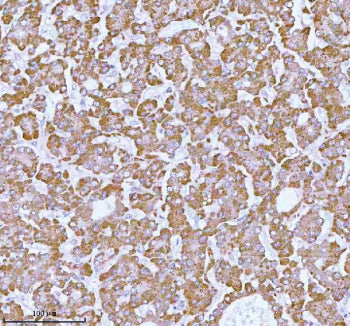
Immunohistochemical staining using ME3 antibody shows mitochondrial localization in hepatocytes, neurons, and renal tubular cells. The ME3 antibody from NSJ Bioreagents is an excellent reagent for studying mitochondrial redox metabolism, energy balance, and biosynthetic regulation.
Share