NSJ Bioreagents
SKU:FY13116
P4HA1 Antibody / Prolyl 4-hydroxylase subunit alpha 1, 100 ug
P4HA1 Antibody / Prolyl 4-hydroxylase subunit alpha 1, 100 ug
Couldn't load pickup availability
P4HA1 antibody detects Prolyl 4-hydroxylase subunit alpha 1, an enzyme that catalyzes hydroxylation of proline residues in collagen. The UniProt recommended name is Prolyl 4-hydroxylase subunit alpha 1 (P4HA1). This enzyme is essential for collagen triple-helix stabilization, extracellular matrix formation, and connective tissue integrity.
Functionally, P4HA1 antibody identifies a 534-amino-acid enzyme localized to the endoplasmic reticulum lumen, where it associates with prolyl 4-hydroxylase beta subunits to form the active tetrameric enzyme. P4HA1 catalyzes the post-translational modification of proline to 4-hydroxyproline, a critical step in collagen maturation that stabilizes the helical structure.
The P4HA1 gene is located on chromosome 10q22.1 and is expressed in fibroblasts, chondrocytes, and osteoblasts. Its expression increases during wound healing, tissue remodeling, and hypoxia. P4HA1 activity is co-regulated with other collagen synthesis enzymes and is sensitive to oxygen and ascorbate availability.
Pathologically, overexpression of P4HA1 has been linked to fibrosis, tumor progression, and hypoxia-induced extracellular matrix remodeling. Elevated P4HA1 enhances collagen deposition and stiffening of the tumor microenvironment, promoting invasion and metastasis. Conversely, inhibition of P4HA1 suppresses collagen accumulation and fibrotic scarring. Research using P4HA1 antibody aids studies in extracellular matrix biology, collagen synthesis, and disease-associated fibrosis.
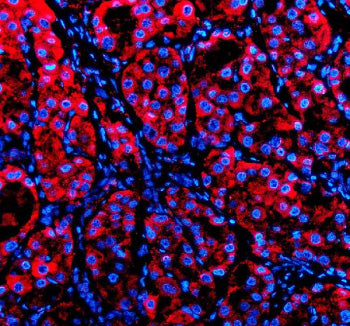
P4HA1 antibody is validated for use in western blotting, immunohistochemistry, and immunofluorescence to detect collagen-modifying enzymes. NSJ Bioreagents offers P4HA1 antibody reagents optimized for studies in connective tissue biology, tumor microenvironment, and molecular pathology.
Structurally, Prolyl 4-hydroxylase subunit alpha 1 contains a catalytic dioxygenase domain that requires Fe2+ and ascorbate as cofactors for hydroxylation. This antibody enables characterization of P4HA1's role in collagen maturation, ECM formation, and disease progression.
Share