NSJ Bioreagents
SKU:FY13081
TTL Antibody / Tubulin-tyrosine ligase, 100 ug
TTL Antibody / Tubulin-tyrosine ligase, 100 ug
Couldn't load pickup availability
TTL antibody detects Tubulin-tyrosine ligase, an essential enzyme responsible for post-translational modification of alpha-tubulin through the addition of a C-terminal tyrosine residue. The UniProt recommended name is Tubulin-tyrosine ligase (TTL). This cytosolic enzyme catalyzes the ATP-dependent retyrosination of detyrosinated alpha-tubulin, maintaining the dynamic equilibrium between tyrosinated and detyrosinated microtubules crucial for cytoskeletal organization and intracellular transport.
Functionally, TTL antibody identifies a 377-amino-acid enzyme that activates free tyrosine and transfers it to the exposed C-terminal glutamate of alpha-tubulin. This reversible modification, known as the tubulin tyrosination cycle, is fundamental to microtubule turnover, stability, and interactions with motor proteins such as kinesin and dynein. TTL activity regulates cell polarity, mitotic spindle assembly, and vesicle trafficking by modulating microtubule dynamics.
The TTL gene is located on chromosome 2q13 and is ubiquitously expressed, with high levels in brain, heart, and skeletal muscle. TTL's enzymatic cycle complements that of tubulin carboxypeptidase, ensuring balanced tyrosination of alpha-tubulin. This modification acts as a spatial cue for motor proteins and microtubule-associated proteins that distinguish dynamic from stable microtubules.
Pathologically, loss or suppression of TTL expression has been linked to tumor progression, neurodegeneration, and impaired axonal transport. In cancer, reduced TTL correlates with increased detyrosinated tubulin, enhancing cell migration and invasion. In neurons, TTL deficiency disturbs axonal guidance and synaptic function. Research using TTL antibody helps elucidate these processes by revealing spatial and temporal patterns of tubulin modification.
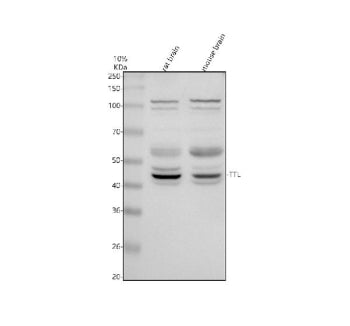
TTL antibody is suitable for western blotting, immunocytochemistry, and immunofluorescence to detect tyrosinated tubulin and monitor microtubule dynamics. NSJ Bioreagents provides validated TTL antibody reagents optimized for studies in cytoskeletal regulation, neurobiology, and cancer cell biology.
Structurally, TTL contains an ATP-grasp catalytic fold that binds tyrosine and alpha-tubulin. The enzyme's activity depends on its recognition of the unmodified C-terminus of alpha-tubulin and coordination of divalent cations for catalysis. This antibody enables researchers to investigate tubulin modification, microtubule behavior, and cellular architecture regulation.
Share