NSJ Bioreagents
SKU:FY12981
SON Antibody / Protein SON, 100 ug
SON Antibody / Protein SON, 100 ug
Couldn't load pickup availability
SON antibody detects Protein SON, a large nuclear RNA-binding protein involved in pre-mRNA splicing, transcriptional regulation, and genome organization. The UniProt recommended name is Protein SON (SON), a multifunctional factor that facilitates RNA processing and gene expression fidelity. SON plays critical roles in maintaining nuclear speckle organization, coordinating spliceosome function, and ensuring accurate mRNA maturation.
Functionally, SON antibody identifies a 2,426-amino-acid nuclear protein characterized by multiple low-complexity regions, a G-patch domain, and RNA recognition motifs. SON interacts with splicing factors, including SRSF2, PRPF8, and U2AF65, promoting efficient intron removal and exon definition. It acts as a scaffold within nuclear speckles, organizing splicing regulators and transcription machinery. SON also participates in the transcriptional regulation of genes governing cell cycle progression, differentiation, and chromatin stability.
The SON gene is located on chromosome 21q22.11 and is highly conserved across vertebrates. It is ubiquitously expressed but enriched in proliferating cells, reflecting its role in transcription-coupled RNA processing. Depletion of SON results in global splicing defects, preferentially affecting long genes with weak splice sites and GC-rich regions. These defects lead to downregulation of critical regulators of DNA replication, chromosome segregation, and pluripotency.
Mutations or haploinsufficiency of SON cause ZTTK syndrome (Zhu-Tokita-Takenouchi-Kim syndrome), a developmental disorder characterized by intellectual disability, growth retardation, and brain malformations. SON also influences genome organization by tethering active chromatin domains near nuclear speckles, thereby enhancing transcriptional efficiency. In cancer, overexpression of SON supports rapid proliferation and survival by stabilizing mRNAs of oncogenic pathways, including MYC and WNT signaling components.
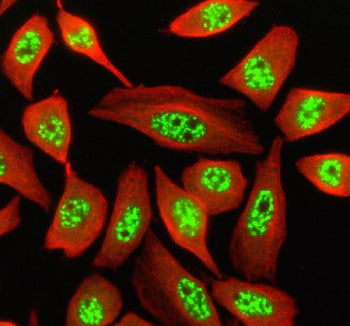
SON antibody is widely used in molecular biology and nuclear organization research. It is suitable for immunoblotting, immunofluorescence, and RNA immunoprecipitation to examine SON's role in splicing and chromatin architecture. SON serves as a nuclear speckle marker in microscopy, distinguishing transcriptionally active nuclear domains. In developmental biology, SON detection aids in characterizing splicing fidelity and gene expression networks critical for tissue differentiation.
Structurally, SON contains numerous serine/arginine-rich and glycine-rich motifs that mediate protein and RNA interactions. Phosphorylation regulates its association with spliceosomal complexes and nuclear bodies. NSJ Bioreagents provides SON antibody reagents validated for use in RNA processing, nuclear organization, and developmental biology research.
Share