NSJ Bioreagents
SKU:FY12934
TMOD1 Antibody / Tropomodulin 1, 100 ug
TMOD1 Antibody / Tropomodulin 1, 100 ug
Couldn't load pickup availability
TMOD1 antibody detects tropomodulin-1, a key actin filament capping protein that regulates the length and stability of actin filaments in muscle and non-muscle cells. The UniProt recommended name is Tropomodulin-1 (TMOD1), with alternate names erythrocyte tropomodulin, TMOD, and E-Tmod. TMOD1 binds to the pointed (minus) end of actin filaments, preventing actin polymerization or depolymerization and thereby maintaining precise filament lengths essential for cytoskeletal integrity and contractile function.
In striated muscle, TMOD1 antibody identifies the isoform predominantly expressed in cardiac and slow skeletal muscle fibers, where it associates with tropomyosin and actin at the pointed end of thin filaments. TMOD1 plays an important role in sarcomere organization, length control, and muscle elasticity. Deficiency or mutation of TMOD1 disrupts sarcomere alignment, leading to myofibrillar disarray and cardiomyopathy phenotypes. In non-muscle cells, TMOD1 is involved in maintaining cortical actin networks, cell shape, and motility, particularly in erythrocytes where it preserves membrane mechanical stability and deformability.
TMOD1 antibody is used to study cytoskeletal architecture, cardiac muscle structure, and erythrocyte morphology. TMOD1 interacts with tropomyosin isoforms (TPM1-4) and capping proteins, coordinating actin filament dynamics during cell movement and myofibrillogenesis. In cardiac development, TMOD1 expression begins early in embryogenesis, highlighting its importance for contractile apparatus assembly. The TMOD1 gene, located on chromosome 9q22.33, encodes a 359-amino acid cytosolic protein that contains tropomyosin-binding and actin-capping domains. TMOD1 operates together with its isoforms TMOD2, TMOD3, and TMOD4, each showing tissue-specific distribution and regulatory mechanisms.
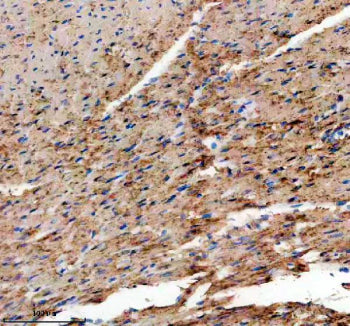
Altered TMOD1 expression has been linked to dilated cardiomyopathy, hereditary spherocytosis, and various muscle weakness disorders. Research also suggests TMOD1's involvement in cell adhesion, migration, and neuronal growth cone dynamics. Detection with TMOD1 antibody in immunostaining and western blot analyses allows detailed exploration of its role in filament organization and cell morphology under normal and disease conditions. NSJ Bioreagents provides validated TMOD1 reagents for human, mouse, and rat applications, ensuring consistent specificity for both cytoskeletal and myocyte research contexts.
Share