NSJ Bioreagents
SKU:FY12836
TWNK Antibody / Twinkle, 100 ug
TWNK Antibody / Twinkle, 100 ug
Couldn't load pickup availability
TWNK antibody detects Twinkle, a mitochondrial DNA helicase essential for mtDNA replication and maintenance. Encoded by the TWNK gene on chromosome 10q24.31, this nuclear-encoded protein is imported into mitochondria, where it unwinds double-stranded DNA to facilitate replication of the mitochondrial genome. Twinkle is a member of the replicative helicase family related to bacteriophage T7 gene 4 helicase-primase, and it plays a vital role in mtDNA stability and copy number control.
Structurally, Twinkle forms a hexameric ring that encircles DNA and uses ATP hydrolysis to unwind duplex strands at replication forks. It cooperates with mitochondrial DNA polymerase gamma (POLG) and mitochondrial single-stranded DNA-binding protein (mtSSB) to sustain replication fidelity and genome integrity. Twinkle localizes to mitochondrial nucleoids, the structures where replication and transcription occur.
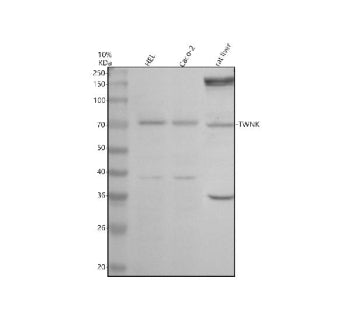
The TWNK antibody is widely used in mitochondrial biology, genetics, and metabolic research to study mtDNA replication, maintenance, and disorders of mitochondrial dysfunction. Western blot analysis detects a 77 kilodalton band corresponding to Twinkle, while immunofluorescence reveals mitochondrial localization with a punctate pattern. This antibody supports investigations into mechanisms of mtDNA propagation and repair.
Mutations in TWNK cause autosomal dominant progressive external ophthalmoplegia (PEO) and mitochondrial DNA depletion syndromes, leading to neuromuscular and metabolic disorders. Dysfunctional Twinkle results in replication stalling, deletions, and depletion of mitochondrial DNA. The TWNK antibody provides a reliable tool for studying mitochondrial replication machinery, genome stability, and related diseases. NSJ Bioreagents validates this antibody for western blotting, immunohistochemistry, and immunofluorescence, ensuring accurate detection for mitochondrial research.
Share