NSJ Bioreagents
SKU:FY12778
STAT5A/B Antibody / Signal transducer and activator of transcription 5, 100 ug
STAT5A/B Antibody / Signal transducer and activator of transcription 5, 100 ug
Couldn't load pickup availability
STAT5A/B antibody detects Signal transducer and activator of transcription 5A and 5B, two closely related transcription factors that mediate cytokine, hormone, and growth factor signaling. Encoded by the STAT5A and STAT5B genes on chromosome 17q21.2, these proteins are members of the STAT family that become phosphorylated and activated downstream of Janus kinases (JAKs). STAT5A and STAT5B share more than 90% sequence identity and function cooperatively to regulate transcription of genes involved in proliferation, survival, and differentiation, particularly in hematopoietic, immune, and mammary tissues.
Upon activation by cytokines such as prolactin, interleukin-2, and growth hormone, STAT5A/B are phosphorylated on a conserved tyrosine residue (Y694 in STAT5A, Y699 in STAT5B), leading to dimerization and nuclear translocation. In the nucleus, they bind specific DNA motifs (GAS elements) to induce transcription of target genes including BCL2L1, CISH, SOCS2, and CCND1. These targets control cell survival, feedback inhibition, and differentiation pathways across multiple systems. STAT5A plays key roles in mammary gland development and lactation, while STAT5B predominantly regulates growth hormone signaling and immune function.
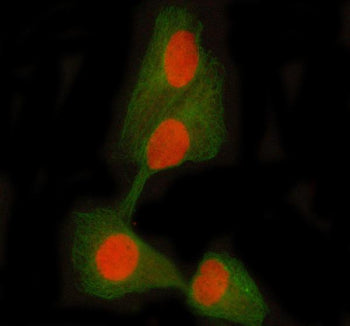
The STAT5A/B antibody is widely used in signal transduction, oncology, and immunology research to detect both STAT5 isoforms in total or phosphorylated forms. Western blot analysis identifies bands near 90 kilodaltons corresponding to STAT5A and STAT5B, while immunofluorescence reveals nuclear accumulation following cytokine stimulation. This antibody supports studies of JAK/STAT pathway activation, cytokine signaling, and transcriptional regulation in various tissues.
Dysregulation of STAT5 signaling is implicated in leukemias, lymphomas, and solid tumors, where constitutive activation promotes oncogenic transformation and resistance to apoptosis. Aberrant STAT5 activity also contributes to autoimmune and inflammatory diseases. The STAT5A/B antibody enables researchers to evaluate STAT pathway activation in both physiological and pathological contexts. NSJ Bioreagents provides this antibody validated for its applications, ensuring precise detection in studies of cytokine-mediated transcription and signal transduction.
Share