NSJ Bioreagents
SKU:FY12466
MS4A4E Antibody / Membrane-spanning 4-domains subfamily A member 4E, 100 ug
MS4A4E Antibody / Membrane-spanning 4-domains subfamily A member 4E, 100 ug
Couldn't load pickup availability
MS4A4E antibody detects Membrane-spanning 4-domains subfamily A member 4E, a member of the MS4A gene family involved in cell signaling, membrane organization, and immune cell communication. Proteins in this family share a conserved topology with four transmembrane helices and cytoplasmic N- and C-termini. MS4A4E, like other MS4A proteins, is thought to participate in the assembly of receptor complexes and in modulating calcium fluxes across cellular membranes. The MS4A4E antibody is widely used for studying membrane microdomain organization, immune function, and the signaling mechanisms that govern inflammatory and neurodegenerative processes.
MS4A4E is encoded by the MS4A4E gene located on human chromosome 11q12.2, within a gene cluster that includes MS4A1 (CD20), MS4A2 (Fc epsilon R1 beta), and several related family members. These proteins are often expressed in immune and epithelial tissues and are implicated in signal transduction pathways associated with receptor activation. MS4A4E is particularly abundant in microglia and macrophages, where it may modulate inflammatory responses and phagocytosis. Studies suggest that it could also play a role in neuronal-glial communication, making it a candidate gene of interest in neuroimmunology and Alzheimer's disease research.
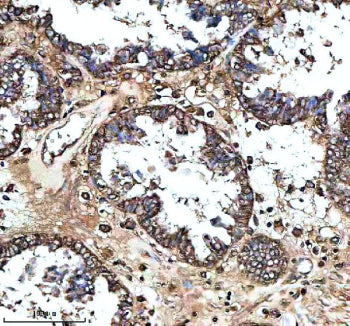
The MS4A4E antibody is useful for western blotting, immunohistochemistry, and flow cytometry applications. Immunostaining shows membrane localization with enrichment at lipid raft domains, consistent with its predicted role in membrane signaling complexes. Research indicates that MS4A4E may interact with adaptor proteins and kinases, forming multi-protein assemblies that regulate signal amplification following receptor engagement. Dysregulation of MS4A4E expression has been reported in inflammatory conditions and neurodegenerative disease models, underscoring its functional relevance in immune signaling and brain homeostasis.
Beyond immunological contexts, MS4A4E is also implicated in epithelial barrier integrity and intercellular adhesion. Variants in MS4A4E have been linked through genome-wide association studies to altered risk of late-onset Alzheimer's disease, likely due to its regulatory relationship with MS4A6A and TREM2 pathways involved in microglial activation. Functional studies continue to explore whether MS4A4E influences receptor trafficking or calcium mobilization during immune activation. NSJ Bioreagents provides a validated MS4A4E antibody optimized for western blot, immunofluorescence, and tissue staining applications, supporting researchers studying membrane signaling, immune modulation, and neuroinflammation.
Share