NSJ Bioreagents
SKU:FY12296
FASLG Antibody / FASL / Fas ligand, 100 ug
FASLG Antibody / FASL / Fas ligand, 100 ug
Couldn't load pickup availability
FASLG antibody detects Fas ligand, encoded by the FASLG gene on chromosome 1q23. FASLG antibody is widely applied in apoptosis, immune regulation, and cancer biology. Fas ligand is a type II transmembrane protein belonging to the TNF superfamily that induces apoptosis by binding its receptor Fas (CD95). This ligand-receptor interaction is essential for immune homeostasis, cytotoxic T cell function, and elimination of damaged or malignant cells.
Structurally, Fas ligand is a ~40 kDa protein with a short cytoplasmic tail, a transmembrane region, and a TNF homology domain that mediates trimerization and receptor binding. Fas ligand exists in membrane-bound and soluble forms, the latter generated by proteolytic cleavage. Membrane-bound Fas ligand is the primary inducer of apoptosis, whereas soluble Fas ligand modulates immune signaling and inflammation.
Functionally, Fas ligand is expressed on activated T cells, NK cells, and certain tissues. Engagement of Fas receptor by Fas ligand recruits FADD and initiates caspase-8 activation, leading to apoptosis. Beyond apoptosis, Fas ligand contributes to immune privilege, inflammation, and tissue injury. Researchers use FASLG antibody to study apoptosis, cytotoxic lymphocyte activity, and immune regulation.
Clinically, mutations in FASLG cause autoimmune lymphoproliferative syndrome (ALPS), characterized by defective lymphocyte apoptosis. Dysregulation of Fas ligand contributes to autoimmune disease, transplant rejection, and cancer immune evasion. Tumors exploit Fas ligand expression to induce apoptosis of infiltrating immune cells, aiding immune escape. Because of its dual roles in immune surveillance and pathology, Fas ligand is a target for therapeutic modulation. NSJ Bioreagents supplies FASLG antibody for immunology, apoptosis, and cancer studies.
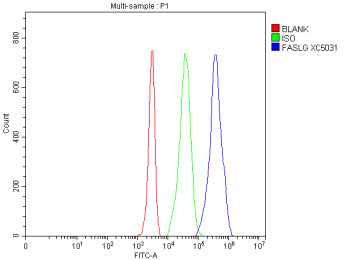
Experimentally, FASLG antibody is applied in western blotting to detect the ~40 kDa protein, in flow cytometry to measure surface expression, and in immunohistochemistry to study tissue-specific regulation. Functional assays using FASLG antibody evaluate apoptosis induction in cell models.
Share