NSJ Bioreagents
SKU:FY12289
CEP135 Antibody / Centrosomal protein 135, 100 ug
CEP135 Antibody / Centrosomal protein 135, 100 ug
Couldn't load pickup availability
CEP135 antibody detects Centrosomal protein of 135 kDa, encoded by the CEP135 gene on chromosome 4q12. CEP135 antibody is widely used in studies of centrosome biology, microtubule organization, and cell division. CEP135 is a core centrosomal protein that contributes to centriole structure and duplication, essential processes for accurate chromosome segregation during mitosis. It is a scaffold protein that supports assembly of other centriolar proteins and contributes to centrosome maturation.
Structurally, CEP135 is a ~135 kDa coiled-coil protein localized to the proximal region of centrioles. It interacts with structural proteins such as SAS-6, CPAP, and STIL, which regulate centriole duplication and elongation. CEP135 provides a platform for organizing microtubule triplets and stabilizing centriole structure.
Functionally, CEP135 is required for proper centriole biogenesis, centrosome integrity, and spindle assembly. Loss of CEP135 leads to abnormal centriole structure, defective spindle formation, and chromosomal instability. Researchers use CEP135 antibody to study cell cycle regulation, centrosome duplication, and mechanisms of chromosomal segregation.
Clinically, mutations in CEP135 are linked to primary microcephaly, a neurodevelopmental disorder caused by defective centrosome function. CEP135 deficiency results in reduced brain size due to impaired neural progenitor proliferation. Dysregulation of centrosome proteins including CEP135 has also been associated with cancer, where centrosome amplification contributes to genomic instability. NSJ Bioreagents provides CEP135 antibody for research in neurodevelopment, cell cycle regulation, and oncology.
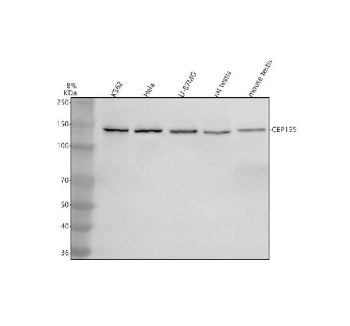
Experimentally, CEP135 antibody is used in western blotting to detect the ~135 kDa protein, in immunofluorescence to visualize centrosomal localization, and in immunohistochemistry to analyze tissue-specific expression. Co-immunoprecipitation with CEP135 antibody identifies interaction partners such as SAS-6 and CPAP.
Share