NSJ Bioreagents
SKU:FY12186
SIK3 Antibody / Salt-inducible kinase 3, 100 ug
SIK3 Antibody / Salt-inducible kinase 3, 100 ug
Couldn't load pickup availability
SIK3 antibody detects Salt-inducible kinase 3, encoded by the SIK3 gene on chromosome 11q23.3. SIK3 antibody is applied in research on energy metabolism, circadian rhythms, and signaling regulation. SIK3 belongs to the AMP-activated protein kinase (AMPK) family of serine/threonine kinases and is activated by phosphorylation. It functions as a central regulator of metabolic homeostasis, coupling nutrient availability with cellular processes such as lipid metabolism, gluconeogenesis, and sleep regulation. Expression is observed across many tissues, with particularly high levels in liver, skeletal muscle, adipose tissue, and brain.
Structurally, SIK3 contains an N-terminal kinase domain, a central ubiquitin-associated domain, and a C-terminal regulatory region. Activation is mediated by phosphorylation at conserved sites by upstream kinases such as LKB1. SIK3 shares structural homology with SIK1 and SIK2 but has distinct tissue distribution and regulatory functions. Nuclear localization sequences and cytoplasmic retention motifs regulate its dynamic shuttling in response to signals.
Functionally, SIK3 controls metabolic processes by phosphorylating transcriptional regulators and metabolic enzymes. In the liver, SIK3 suppresses gluconeogenic gene expression, while in adipose tissue it promotes lipogenesis. In the brain, SIK3 regulates circadian rhythms and sleep architecture by modulating transcriptional feedback loops. Knockout models show defects in lipid metabolism, growth, and sleep, underscoring its essential roles in physiology. Researchers use SIK3 antibody to explore energy balance, circadian biology, and kinase signaling networks.
Clinically, SIK3 variants have been linked to metabolic disorders, including obesity, type 2 diabetes, and dyslipidemia. Genome-wide association studies identify polymorphisms in SIK3 as contributors to body mass index variation. In addition, SIK3 mutations have been implicated in sleep disorders and neurodevelopmental syndromes. SIK3 activity is also relevant to cancer, where it influences cell growth and survival pathways. NSJ Bioreagents supplies SIK3 antibody to support research into metabolism, neurobiology, and cancer signaling.
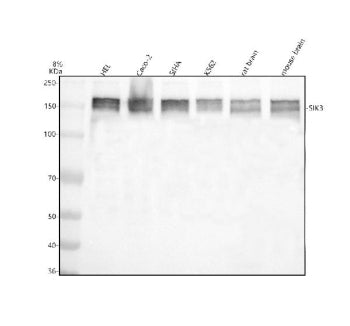
Experimentally, SIK3 antibody is used in western blotting to detect the ~140 kDa protein, in immunohistochemistry to study tissue expression, and in immunofluorescence microscopy to visualize intracellular distribution. Immunoprecipitation with SIK3 antibody enables identification of substrates and binding partners. These approaches facilitate analysis of SIK3-dependent signaling in both metabolic and neurological contexts.
Share