1
/
of
1
NSJ Bioreagents
SKU:F47635-0.08ML
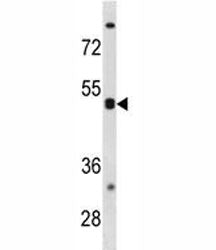
CXCR5 Antibody / BLR1 / MDR15
CXCR5 Antibody / BLR1 / MDR15
Regular price
$205.00 USD
Regular price
Sale price
$205.00 USD
Unit price
/
per
Shipping calculated at checkout.
Couldn't load pickup availability
This gene was identified as a gene specifically expressed in Burkitt's lymphoma and lymphatic tissues. The protein encoded by this gene is predicted to be a seven transmembrane G protein- coupled receptor and belongs to the CXC chemokine receptor family. BLC, a B-lymphocyte chemoattractant, was identified to be a specific ligand for this receptor. Studies of this gene and its mouse conterpart strongly suggest the essential function of this gene in B cell migration and localization within specific anatomic compartments, such as follicles in lymph nodes as well as in spleen. Two alternatively spliced variants of this gene exist.
Specifications
| Family | Primary antibody |
|---|---|
| Formulation | In 1X PBS, pH 7.4, with 0.09% sodium azide |
| Format | Antigen affinity purified |
| Host Animal | Rabbit |
| Clonality | Polyclonal (rabbit origin) |
| Isotype | Rabbit Ig |
| Species Reactivity | Human |
| Application | WB, ELISA |
| Application Details | Western blot: 1:1000 |
| Application Note | Titration of the CXCR5 antibody may be required due to differences in protocols and secondary/substrate sensitivity. |
| Immunogen | A portion of amino acids 1-30 from the human protein was used as the immunogen for this CXCR5 antibody. |
| Purity | Antigen affinity |
| Storage | Aliquot the CXCR5 antibody and store frozen at -20oC or colder. Avoid repeated freeze-thaw cycles. |
| Limitation | This CXCR5 antibody is available for research use only. |
| Uniprot # | P32302 |
| Status | Available |
| PDF Link | https://www.nsjbio.com/tds-pdf/cxcr5-antibody-blr1-mdr15-f47635 |
| Title | CXCR5 Antibody / BLR1 / MDR15 |
| Description | This gene was identified as a gene specifically expressed in Burkitt's lymphoma and lymphatic tissues. The protein encoded by this gene is predicted to be a seven transmembrane G protein- coupled receptor and belongs to the CXC chemokine receptor family. BLC, a B-lymphocyte chemoattractant, was identified to be a specific ligand for this receptor. Studies of this gene and its mouse conterpart strongly suggest the essential function of this gene in B cell migration and localization within specific anatomic compartments, such as follicles in lymph nodes as well as in spleen. Two alternatively spliced variants of this gene exist. |
Share