1
/
of
1
NSJ Bioreagents
SKU:F54422-0.08ML
CTSE Antibody / Cathepsin E
CTSE Antibody / Cathepsin E
Regular price
$205.00 USD
Regular price
Sale price
$205.00 USD
Unit price
/
per
Shipping calculated at checkout.
Couldn't load pickup availability
CTSE is a gastric aspartyl protease that functions as a disulfide-linked homodimer. This protease, which is a member of the peptidase C1 family, has a specificity similar to that of pepsin A and cathepsin D. It is an intracellular proteinase that does not appear to be involved in the digestion of dietary protein and is found in highest concentration in the surface of epithelial mucus-producing cells of the stomach. It is the first aspartic proteinase expressed in the fetal stomach and is found in more than half of gastric cancers. It appears, therefore, to be an oncofetal antigen.
Specifications
| Family | Primary antibody |
|---|---|
| Formulation | In 1X PBS, pH 7.4, with 0.09% sodium azide |
| Format | Purified |
| Host Animal | Rabbit |
| Clonality | Polyclonal (rabbit origin) |
| Isotype | Rabbit Ig |
| Species Reactivity | Human, Mouse, Rat |
| Application | WB, FACS, IHC-P |
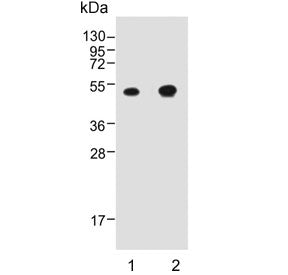
| Application Details | Western blot: 1:500-1:2000,Flow cytometry: 1:25 (1x10e6 cells),Immunohistochemistry (FFPE): 1:25 |
| Application Note | The stated application concentrations are suggested starting points. Titration of the CTSE antibody may be required due to differences in protocols and secondary/substrate sensitivity. |
| Immunogen | A portion of amino acids 157-187 from the human protein was used as the immunogen for the CTSE antibody. |
| Purity | Antigen affinity purified |
| Storage | Aliquot the CTSE antibody and store frozen at -20oC or colder. Avoid repeated freeze-thaw cycles. |
| Limitation | This CTSE antibody is available for research use only. |
| Uniprot # | P14091 |
| Status | Available |
| PDF Link | https://www.nsjbio.com/tds-pdf/ctse-antibody-cathepsin-e-f54422 |
| Title | CTSE Antibody / Cathepsin E |
| Description | CTSE is a gastric aspartyl protease that functions as a disulfide-linked homodimer. This protease, which is a member of the peptidase C1 family, has a specificity similar to that of pepsin A and cathepsin D. It is an intracellular proteinase that does not appear to be involved in the digestion of dietary protein and is found in highest concentration in the surface of epithelial mucus-producing cells of the stomach. It is the first aspartic proteinase expressed in the fetal stomach and is found in more than half of gastric cancers. It appears, therefore, to be an oncofetal antigen. |
Share