1
/
of
1
NSJ Bioreagents
SKU:RQ5715
CLDN5 Antibody / Claudin 5
CLDN5 Antibody / Claudin 5
Regular price
$449.00 USD
Regular price
Sale price
$449.00 USD
Unit price
/
per
Shipping calculated at checkout.
Couldn't load pickup availability
Claudin-5 is a protein that in humans is encoded by the CLDN5 gene. This gene encodes a member of the claudin family. Claudins are integral membrane proteins and components of tight junction strands. Tight junction strands serve as a physical barrier to prevent solutes and water from passing freely through the paracellular space between epithelial or endothelial cell sheets. Mutations in this gene have been found in patients with velocardiofacial syndrome. Alternative splicing results in multiple transcript variants encoding distinct isoforms.
Specifications
| Family | Primary antibody |
|---|---|
| Formulation | 0.5mg/ml if reconstituted with 0.2ml sterile DI water |
| Format | Antigen affinity purified |
| Host Animal | Rabbit |
| Clonality | Polyclonal |
| Isotype | Rabbit IgG |
| Species Reactivity | Human |
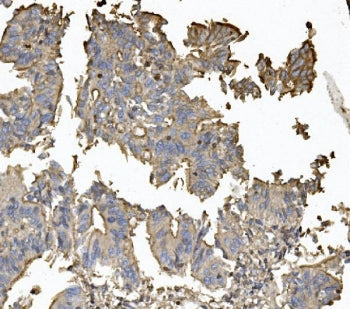
| Application | IHC-P, IF |
| Application Details | Immunohistochemistry (FFPE): 1-2ug/ml,Immunofluorescence: 2-4ug/ml |
| Application Note | Optimal dilution of the CLDN5 antibody should be determined by the researcher. |
| Immunogen | Amino acids KYSAPRRPTATGDYDKKNYV from the human protein were used as the immunogen for the CLDN5 antibody. |
| Buffer | Lyophilized from 1X PBS with 2% Trehalose and 0.025% sodium azide |
| Purity | Affinity purified |
| Storage | After reconstitution, the CLDN5 antibody can be stored for up to one month at 4oC. For long-term, aliquot and store at -20oC. Avoid repeated freezing and thawing. |
| Limitation | This CLDN5 antibody is available for research use only. |
| Uniprot # | O00501 |
| Status | Available |
| PDF Link | https://www.nsjbio.com/tds-pdf/cldn5-antibody-claudin-5-rq5715 |
| Title | CLDN5 Antibody / Claudin 5 |
| Description | Claudin-5 is a protein that in humans is encoded by the CLDN5 gene. This gene encodes a member of the claudin family. Claudins are integral membrane proteins and components of tight junction strands. Tight junction strands serve as a physical barrier to prevent solutes and water from passing freely through the paracellular space between epithelial or endothelial cell sheets. Mutations in this gene have been found in patients with velocardiofacial syndrome. Alternative splicing results in multiple transcript variants encoding distinct isoforms. |
Share