1
/
of
1
NSJ Bioreagents
SKU:RQ5806
CINP Antibody
CINP Antibody
Regular price
$449.00 USD
Regular price
Sale price
$449.00 USD
Unit price
/
per
Shipping calculated at checkout.
Couldn't load pickup availability
Cartilage intermediate layer protein 1 is a protein that in humans is encoded by the CILP gene. The protein encoded by this gene is reported to be a component of the DNA replication complex as well as a genome-maintenance protein. It may interact with proteins important for replication initiation and has been shown to bind chromatin at the G1 phase of the cell cycle and dissociate from chromatin with replication initiation. It may also serve to regulate checkpoint signaling as part of the DNA damage response. Alternative splicing results in multiple transcript variants.
Specifications
| Family | Primary antibody |
|---|---|
| Formulation | 0.5mg/ml if reconstituted with 0.2ml sterile DI water |
| Format | Antigen affinity purified |
| Host Animal | Rabbit |
| Clonality | Polyclonal (rabbit origin) |
| Isotype | Rabbit IgG |
| Species Reactivity | Mouse |
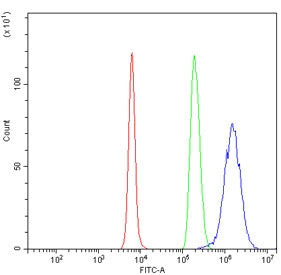
| Application | WB, FACS |
| Application Details | Western blot: 0.5-1ug/ml,Flow cytometry: 1-3ug/million cells |
| Application Note | Optimal dilution of the CINP antibody should be determined by the researcher. |
| Immunogen | Amino acids ARKLKDNAADWHNLILKWDSL from the mouse protein were used as the immunogen for the CINP antibody. |
| Buffer | Lyophilized from 1X PBS with 2% Trehalose and 0.025% sodium azide |
| Purity | Affinity purified |
| Storage | After reconstitution, the CINP antibody can be stored for up to one month at 4oC. For long-term, aliquot and store at -20oC. Avoid repeated freezing and thawing. |
| Limitation | This CINP antibody is available for research use only. |
| Uniprot # | Q9D0V8 |
| Status | Available |
| PDF Link | https://www.nsjbio.com/tds-pdf/cinp-antibody-rq5806 |
| Title | CINP Antibody |
| Description | Cartilage intermediate layer protein 1 is a protein that in humans is encoded by the CILP gene. The protein encoded by this gene is reported to be a component of the DNA replication complex as well as a genome-maintenance protein. It may interact with proteins important for replication initiation and has been shown to bind chromatin at the G1 phase of the cell cycle and dissociate from chromatin with replication initiation. It may also serve to regulate checkpoint signaling as part of the DNA damage response. Alternative splicing results in multiple transcript variants. |
Share