NSJ Bioreagents
SKU:F55073-0.05ML
Choriogonadotropin beta Antibody / HCG-beta
Choriogonadotropin beta Antibody / HCG-beta
Couldn't load pickup availability
Choriogonadotropin beta, also known as beta-hCG, is a hormone produced by the placenta during pregnancy. It plays a key role in maintaining the pregnancy and supporting the development of the fetus. Beta-hCG levels can be detected in a woman's blood or urine as early as 11 days after conception, making it a valuable marker for pregnancy testing. It also has other important functions, such as stimulating the production of progesterone, a hormone that helps maintain the uterine lining and support the developing fetus. In addition, beta-hCG also plays a role in preventing the breakdown of the corpus luteum, a temporary endocrine structure that produces progesterone during early pregnancy.
Specifications
| Family | Primary antibody |
|---|---|
| Formulation | In 1X PBS, pH 7.4, with 0.09% sodium azide |
| Format | Antigen affinity purified |
| Host Animal | Rabbit |
| Clonality | Polyclonal (rabbit origin) |
| Isotype | Rabbit Ig |
| Species Reactivity | Human |
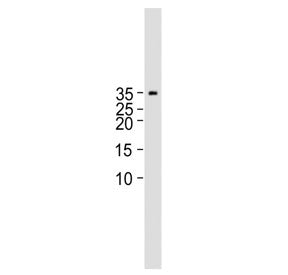
| Application | WB, IHC-P |
| Application Details | Western blot: 1:500-1:1000,Immunohistochemisty (FFPE): 1:10-1:50 |
| Application Note | Titration of the Choriogonadotropin beta antibody may be required due to differences in protocols and secondary/substrate sensitivity. |
| Localization | Cytoplasmic, Secreted |
| Immunogen | A portion of amino acids 137-165 from the human protein was used as the immunogen for this Choriogonadotropin beta antibody. |
| Storage | Aliquot the Choriogonadotropin beta antibody and store frozen at -20oC or colder. Avoid repeated freeze-thaw cycles. |
| Limitation | This Choriogonadotropin beta antibody is available for research use only. |
| Uniprot # | P0DN86 |
| Status | Available |
| PDF Link | http://www.nsjbio.com/tds-pdf/choriogonadotropin-beta-antibody-hcg-beta-f55073 |
| Title | Choriogonadotropin beta Antibody / HCG-beta |
| Description | Choriogonadotropin beta, also known as beta-hCG, is a hormone produced by the placenta during pregnancy. It plays a key role in maintaining the pregnancy and supporting the development of the fetus. Beta-hCG levels can be detected in a woman's blood or urine as early as 11 days after conception, making it a valuable marker for pregnancy testing. It also has other important functions, such as stimulating the production of progesterone, a hormone that helps maintain the uterine lining and support the developing fetus. In addition, beta-hCG also plays a role in preventing the breakdown of the corpus luteum, a temporary endocrine structure that produces progesterone during early pregnancy. |
Share