NSJ Bioreagents
SKU:FY12530
CHAT Antibody / Choline Acetyltransferase
CHAT Antibody / Choline Acetyltransferase
Couldn't load pickup availability
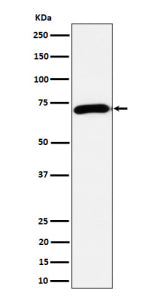
CHAT antibody detects choline acetyltransferase, an enzyme encoded by the CHAT gene that catalyzes the biosynthesis of the neurotransmitter acetylcholine. By transferring an acetyl group from acetyl CoA to choline, CHAT generates acetylcholine, which is essential for cholinergic neurotransmission in both central and peripheral nervous systems. CHAT is expressed in cholinergic neurons and is considered a reliable marker for identifying these cells.<br><br>CHAT antibody is widely used in neuroscience and neurodegenerative disease research. By detecting CHAT, researchers can map cholinergic neuronal populations, study synaptic transmission, and monitor changes in acetylcholine production. Alterations in CHAT activity are linked to disorders including Alzheimer disease, Huntington disease, and amyotrophic lateral sclerosis, where cholinergic dysfunction contributes to pathology.<br><br> In western blot assays, CHAT antibody detects protein bands of expected size in brain and spinal cord extracts. Immunohistochemistry highlights cholinergic neurons in the basal forebrain, brainstem, and motor nuclei. Immunofluorescence provides high resolution visualization of CHAT positive axons and synapses, enabling detailed mapping of cholinergic circuitry. ELISA applications support quantitative measurement of CHAT in research samples.<br><br>CHAT has been implicated in development and plasticity. During embryogenesis, CHAT expression marks differentiation of cholinergic neurons and is used as a tool to study nervous system maturation. In adult brains, changes in CHAT expression reflect synaptic remodeling and disease related degeneration. By applying CHAT antibody, scientists can study the mechanisms underlying acetylcholine regulation and identify therapeutic strategies for restoring cholinergic signaling.<br><br>Beyond neuroscience, CHAT is studied in muscle physiology and autonomic function. It influences neuromuscular transmission and parasympathetic activity, linking it to movement control and visceral regulation. These diverse roles emphasize the value of CHAT antibody across multiple research disciplines.<br><br>CHAT antibody from NSJ Bioreagents provides dependable specificity for detecting choline acetyltransferase in neuronal and non neuronal tissues. Its proven reliability across applications ensures accurate detection of this key enzyme in neurotransmitter biology.
Specifications
| Family | Primary antibody |
|---|---|
| Formulation | Rabbit IgG in phosphate buffered saline, pH 7.4, 150mM NaCl, 0.02% sodium azide and 50% glycerol, 0.4-0.5mg/ml BSA |
| Format | Liquid |
| Clone | 31C75 |
| Host Animal | Rabbit |
| Clonality | Recombinant Rabbit Monoclonal |
| Isotype | Rabbit IgG |
| Species Reactivity | Mouse, Rat |
| Application | WB, IHC |
| Application Details | Western blot: 1:500-1:2000,Immunohistochemistry: 1:50-1:200 |
| Application Note | Optimal dilution of the CHAT antibody should be determined by the researcher. |
| Immunogen | A synthesized peptide derived from human Choline Acetyltransferase was used as the immunogen for the CHAT antibody. |
| Buffer | Rabbit IgG in phosphate buffered saline, pH 7.4, 150mM NaCl, 0.02% sodium azide and 50% glycerol, 0.4-0.5mg/ml BSA. |
| Purity | Affinity-chromatography |
| Storage | Store the CHAT antibody at -20oC. |
| Limitation | This CHAT antibody is available for research use only. |
| Uniprot # | P28329 |
| Status | Available |
| PDF Link | http://www.nsjbio.com/tds-pdf/chat-antibody-choline-acetyltransferase-fy12530-nsj-bioreagents |
| Title | CHAT Antibody / Choline Acetyltransferase |
| Description | CHAT antibody detects choline acetyltransferase, an enzyme encoded by the CHAT gene that catalyzes the biosynthesis of the neurotransmitter acetylcholine. By transferring an acetyl group from acetyl CoA to choline, CHAT generates acetylcholine, which is essential for cholinergic neurotransmission in both central and peripheral nervous systems. CHAT is expressed in cholinergic neurons and is considered a reliable marker for identifying these cells.<br><br>CHAT antibody is widely used in neuroscience and neurodegenerative disease research. By detecting CHAT, researchers can map cholinergic neuronal populations, study synaptic transmission, and monitor changes in acetylcholine production. Alterations in CHAT activity are linked to disorders including Alzheimer disease, Huntington disease, and amyotrophic lateral sclerosis, where cholinergic dysfunction contributes to pathology.<br><br> In western blot assays, CHAT antibody detects protein bands of expected size in brain and spinal cord extracts. Immunohistochemistry highlights cholinergic neurons in the basal forebrain, brainstem, and motor nuclei. Immunofluorescence provides high resolution visualization of CHAT positive axons and synapses, enabling detailed mapping of cholinergic circuitry. ELISA applications support quantitative measurement of CHAT in research samples.<br><br>CHAT has been implicated in development and plasticity. During embryogenesis, CHAT expression marks differentiation of cholinergic neurons and is used as a tool to study nervous system maturation. In adult brains, changes in CHAT expression reflect synaptic remodeling and disease related degeneration. By applying CHAT antibody, scientists can study the mechanisms underlying acetylcholine regulation and identify therapeutic strategies for restoring cholinergic signaling.<br><br>Beyond neuroscience, CHAT is studied in muscle physiology and autonomic function. It influences neuromuscular transmission and parasympathetic activity, linking it to movement control and visceral regulation. These diverse roles emphasize the value of CHAT antibody across multiple research disciplines.<br><br>CHAT antibody from NSJ Bioreagents provides dependable specificity for detecting choline acetyltransferase in neuronal and non neuronal tissues. Its proven reliability across applications ensures accurate detection of this key enzyme in neurotransmitter biology. |
Share