NSJ Bioreagents
SKU:RQ8876
CD24 Antibody
CD24 Antibody
Couldn't load pickup availability
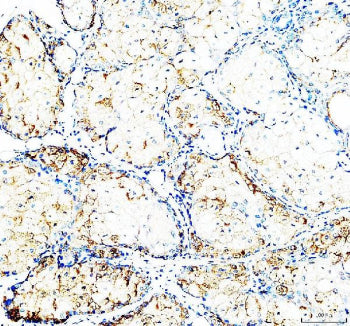
CD24 antibody detects Cluster of differentiation 24, a small glycosylphosphatidylinositol (GPI)-anchored cell surface glycoprotein involved in cell adhesion, immune modulation, and cancer metastasis. Encoded by the CD24 gene on chromosome 6q21, this protein is expressed on developing hematopoietic cells, mature B cells, granulocytes, and various epithelial and neuronal tissues. CD24 mediates cell-cell and cell-matrix interactions by binding to P-selectin and Siglec family receptors, influencing immune cell trafficking and signaling.<br><br>Structurally, CD24 is a heavily glycosylated protein lacking a transmembrane domain, anchored to the plasma membrane via a GPI linkage. The carbohydrate moieties of CD24 contribute to its interactions with lectins and adhesion molecules, which regulate lymphocyte homing and activation. In the nervous system, CD24 is involved in axon growth and synaptic plasticity, while in the immune system it acts as a costimulatory molecule modulating T cell responses. CD24 engagement can influence B cell maturation, dendritic cell activation, and apoptosis signaling.<br><br>The CD24 antibody is widely used in immunology, oncology, and stem cell biology research to study immune signaling, cancer progression, and differentiation. Flow cytometry using this antibody identifies CD24-positive cell populations, while western blot analysis detects the mature glycoprotein at approximately 35-40 kilodaltons, with size variability due to glycosylation. Immunohistochemistry reveals membrane staining in lymphoid tissues and various carcinomas.<br><br>In cancer research, CD24 has emerged as a key marker of tumor-initiating cells and metastasis. Overexpression is associated with aggressive tumor phenotypes in breast, ovarian, and colorectal cancers, where CD24 promotes cell adhesion to P-selectin on platelets and endothelial cells, aiding metastatic spread. Conversely, CD24 expression can modulate immune responses by interacting with Siglec-10, inhibiting innate immune activation. The CD24 antibody is an essential tool for investigating immune regulation, tumor biology, and cell surface glycoprotein signaling. NSJ Bioreagents provides this antibody validated for immunohistochemistry, ensuring high specificity in cellular and molecular studies.
Specifications
| Family | Primary antibody |
|---|---|
| Formulation | 0.5mg/ml if reconstituted with 0.2ml sterile DI water |
| Format | Antigen affinity purified |
| Host Animal | Rabbit |
| Clonality | Polyclonal (rabbit origin) |
| Isotype | Rabbit IgG |
| Species Reactivity | Human |
| Application | IHC-P |
| Application Details | Immunohistochemistry (FFPE): 2-5ug/ml |
| Application Note | Optimal dilution of the CD24 antibody should be determined by the researcher. |
| Immunogen | A synthetic peptide corresponding to a sequence in the middle region of human CD24 protein was used as the immunogen for the CD24 antibody. |
| Buffer | Lyophilized from 1X PBS with 2% Trehalose |
| Purity | Antigen affinity purified |
| Storage | After reconstitution, the CD24 antibody can be stored for up to one month at 4oC. For long-term, aliquot and store at -20oC. Avoid repeated freezing and thawing. |
| Limitation | This CD24 antibody is available for research use only. |
| Uniprot # | P25063 |
| Status | Available |
| PDF Link | http://www.nsjbio.com/tds-pdf/cd24-antibody-rq8876 |
| Title | CD24 Antibody |
| Description | CD24 antibody detects Cluster of differentiation 24, a small glycosylphosphatidylinositol (GPI)-anchored cell surface glycoprotein involved in cell adhesion, immune modulation, and cancer metastasis. Encoded by the CD24 gene on chromosome 6q21, this protein is expressed on developing hematopoietic cells, mature B cells, granulocytes, and various epithelial and neuronal tissues. CD24 mediates cell-cell and cell-matrix interactions by binding to P-selectin and Siglec family receptors, influencing immune cell trafficking and signaling.<br><br>Structurally, CD24 is a heavily glycosylated protein lacking a transmembrane domain, anchored to the plasma membrane via a GPI linkage. The carbohydrate moieties of CD24 contribute to its interactions with lectins and adhesion molecules, which regulate lymphocyte homing and activation. In the nervous system, CD24 is involved in axon growth and synaptic plasticity, while in the immune system it acts as a costimulatory molecule modulating T cell responses. CD24 engagement can influence B cell maturation, dendritic cell activation, and apoptosis signaling.<br><br>The CD24 antibody is widely used in immunology, oncology, and stem cell biology research to study immune signaling, cancer progression, and differentiation. Flow cytometry using this antibody identifies CD24-positive cell populations, while western blot analysis detects the mature glycoprotein at approximately 35-40 kilodaltons, with size variability due to glycosylation. Immunohistochemistry reveals membrane staining in lymphoid tissues and various carcinomas.<br><br>In cancer research, CD24 has emerged as a key marker of tumor-initiating cells and metastasis. Overexpression is associated with aggressive tumor phenotypes in breast, ovarian, and colorectal cancers, where CD24 promotes cell adhesion to P-selectin on platelets and endothelial cells, aiding metastatic spread. Conversely, CD24 expression can modulate immune responses by interacting with Siglec-10, inhibiting innate immune activation. The CD24 antibody is an essential tool for investigating immune regulation, tumor biology, and cell surface glycoprotein signaling. NSJ Bioreagents provides this antibody validated for immunohistochemistry, ensuring high specificity in cellular and molecular studies. |
Share