1
/
of
1
NSJ Bioreagents
SKU:RQ4472
Cathepsin E Antibody / CTSE
Cathepsin E Antibody / CTSE
Regular price
$449.00 USD
Regular price
Sale price
$449.00 USD
Unit price
/
per
Shipping calculated at checkout.
Couldn't load pickup availability
Cathepsin E is an enzyme that in humans is encoded by the CTSE gene. This gene encodes a member of the A1 family of peptidases. Alternative splicing of this gene results in multiple transcript variants. At least one of these variants encodes a preproprotein that is proteolytically processed to generate the mature enzyme. This enzyme, an aspartic endopeptidase, may be involved in antigen processing and the maturation of secretory proteins. Elevated expression of this gene has been observed in neurodegeneration.
Specifications
| Family | Primary antibody |
|---|---|
| Formulation | 0.5mg/ml if reconstituted with 0.2ml sterile DI water |
| Format | Antigen affinity purified |
| Host Animal | Rabbit |
| Clonality | Polyclonal (rabbit origin) |
| Isotype | Rabbit IgG |
| Species Reactivity | Human, Mouse, Rat |
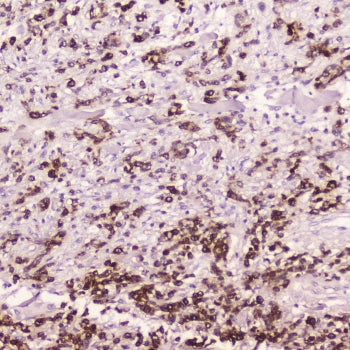
| Application | WB, IHC-P |
| Application Details | Western blot: 0.5-1ug/ml,Immunohistochemistry (FFPE): 1-2ug/ml |
| Application Note | Optimal dilution of the Cathepsin E antibody should be determined by the researcher. |
| Localization | Cytoplasmic, membranous |
| Immunogen | Human Cathepsin E recombinant protein (amino acids A150-R393) was used as the immunogen for the Cathepsin E antibody. |
| Buffer | Lyophilized from 1X PBS with 2% Trehalose and 0.025% sodium azide |
| Purity | Antigen affinity |
| Storage | After reconstitution, the Cathepsin E antibody can be stored for up to one month at 4oC. For long-term, aliquot and store at -20oC. Avoid repeated freezing and thawing. |
| Limitation | This Cathepsin E antibody is available for research use only. |
| Uniprot # | P14091 |
| Status | Available |
| PDF Link | https://www.nsjbio.com/tds-pdf/cathepsin-e-antibody-ctse-rq4472 |
| Title | Cathepsin E Antibody / CTSE |
| Description | Cathepsin E is an enzyme that in humans is encoded by the CTSE gene. This gene encodes a member of the A1 family of peptidases. Alternative splicing of this gene results in multiple transcript variants. At least one of these variants encodes a preproprotein that is proteolytically processed to generate the mature enzyme. This enzyme, an aspartic endopeptidase, may be involved in antigen processing and the maturation of secretory proteins. Elevated expression of this gene has been observed in neurodegeneration. |
Share