1
/
of
1
NSJ Bioreagents
SKU:R31215
Caspase-12 Antibody
Caspase-12 Antibody
Regular price
$449.00 USD
Regular price
Sale price
$449.00 USD
Unit price
/
per
Shipping calculated at checkout.
Couldn't load pickup availability
Caspase-12 is an enzyme known as a cysteine protease. It belongs to a family of enzymes called caspases that cleave their substrates at C-terminal aspartic acid residues. The CASP12 gene was mapped to chromosome 11q22.3. Caspase-12 attenuates the inflammatory and innate immune response to endotoxins and in doing so may constitute a risk factor for developing sepsis. The estrogen-mediated inhibition of its expression is a built-in mechanism that has evolved to protect females from infection by favoring a more robust inflammatory response to pathogens, perhaps notably in childbirth.
Specifications
| Family | Primary antibody |
|---|---|
| Formulation | 0.5mg/ml if reconstituted with 0.2ml sterile DI water |
| Format | Antigen affinity purified |
| Host Animal | Rabbit |
| Clonality | Polyclonal (rabbit origin) |
| Isotype | Rabbit IgG |
| Species Reactivity | Human |
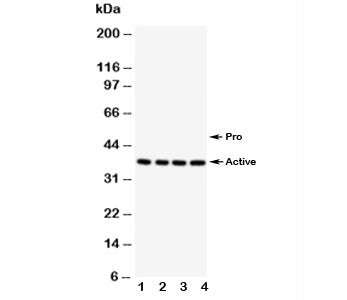
| Application | WB, IHC-P |
| Application Details | Western blot: 0.5-1ug/ml,IHC (FFPE): 0.5-1ug/ml |
| Application Note | The stated application concentrations are suggested starting points. Titration of the Caspase-12 antibody may be required due to differences in protocols and secondary/substrate sensitivity. |
| Immunogen | Amino acids 71-84 (KIFREHLWNSKKQL-human) were used as the immunogen for this Caspase-12 antibody. |
| Buffer | Lyophilized from 1X PBS with 2.5% BSA and 0.025% sodium azide/thimerosal |
| Purity | Antigen affinity |
| Storage | After reconstitution, the Caspase-12 antibody can be stored for up to one month at 4oC. For long-term, aliquot and store at -20oC. Avoid repeated freezing and thawing. |
| Limitation | This Caspase-12 antibody is available for research use only. |
| Uniprot # | Q6UXS9 |
| Status | Available |
| PDF Link | https://www.nsjbio.com/tds-pdf/caspase-12-antibody-r31215 |
| Title | Caspase-12 Antibody |
| Description | Caspase-12 is an enzyme known as a cysteine protease. It belongs to a family of enzymes called caspases that cleave their substrates at C-terminal aspartic acid residues. The CASP12 gene was mapped to chromosome 11q22.3. Caspase-12 attenuates the inflammatory and innate immune response to endotoxins and in doing so may constitute a risk factor for developing sepsis. The estrogen-mediated inhibition of its expression is a built-in mechanism that has evolved to protect females from infection by favoring a more robust inflammatory response to pathogens, perhaps notably in childbirth. |
Share