NSJ Bioreagents
SKU:FY13246
CASP3 Antibody / Caspase 3
CASP3 Antibody / Caspase 3
Couldn't load pickup availability
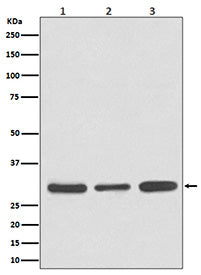
CASP3 antibody detects Caspase 3, encoded by the CASP3 gene. Caspase 3 is a cysteine aspartic protease that functions as an executioner caspase in apoptosis. Activated downstream of initiator caspases, Caspase 3 cleaves a broad spectrum of cellular substrates, leading to programmed cell death. CASP3 antibody provides researchers with an essential tool for investigating apoptosis, cancer biology, and neurodegeneration.<br><br>Caspase 3 is synthesized as an inactive zymogen that undergoes proteolytic cleavage during apoptosis to generate the active enzyme. Research using CASP3 antibody has demonstrated that activated Caspase 3 cleaves structural proteins, DNA repair enzymes, and signaling molecules, dismantling cellular architecture and promoting apoptotic progression. Its activity is a hallmark of programmed cell death and is widely used as a biomarker of apoptosis in experimental systems.<br><br>In cancer research, studies with CASP3 antibody have revealed that impaired Caspase 3 activation contributes to resistance to chemotherapy and radiation therapy. Tumors that downregulate or inactivate Caspase 3 evade apoptosis, enhancing survival and proliferation. Conversely, forced activation of Caspase 3 promotes cell death and tumor regression. These observations highlight Caspase 3 as a potential therapeutic target and prognostic marker in oncology.<br><br>Caspase 3 also plays critical roles in neurodegeneration. Research using CASP3 antibody has shown that aberrant Caspase 3 activity contributes to neuronal loss in diseases such as Alzheimer's, Parkinson's, and Huntington's. Excessive activation promotes neuronal apoptosis, while inhibition has been explored as a neuroprotective strategy. Beyond the nervous system, Caspase 3 regulates apoptosis in immune cells, cardiac cells, and developmental processes, reflecting its broad biological importance.<br><br>CASP3 antibody is widely used in western blotting, immunohistochemistry, flow cytometry, and ELISA. Western blotting distinguishes full length and cleaved forms, immunohistochemistry detects apoptotic cells in tissue, flow cytometry quantifies apoptosis in cell populations, and ELISA measures Caspase 3 activity in lysates. These applications make CASP3 antibody indispensable for apoptosis research.<br><br>By supplying validated CASP3 antibody reagents, NSJ Bioreagents supports research into apoptosis, cancer, and neurodegeneration. Detection of Caspase 3 provides researchers with a reliable marker of programmed cell death and a tool for exploring therapeutic interventions.
Specifications
| Family | Primary antibody |
|---|---|
| Formulation | Rabbit IgG in phosphate buffered saline, pH 7.4, 150mM NaCl, 0.02% sodium azide and 50% glycerol, 0.4-0.5mg/ml BSA |
| Format | Liquid |
| Clone | 30C96 |
| Host Animal | Rabbit |
| Clonality | Recombinant Rabbit Monoclonal |
| Isotype | Rabbit IgG |
| Species Reactivity | Human, Mouse, Rat |
| Application | WB, IHC, IP |
| Application Details | Western blot: 1:500-1:2000,Immunohistochemistry: 1:50-1:200,Immunoprecipitation: 1:50 |
| Application Note | Optimal dilution of the CASP3 antibody should be determined by the researcher. |
| Immunogen | A synthesized peptide derived from human Caspase 3 was used as the immunogen for the CASP3 antibody. |
| Buffer | Rabbit IgG in phosphate buffered saline, pH 7.4, 150mM NaCl, 0.02% sodium azide and 50% glycerol, 0.4-0.5mg/ml BSA. |
| Purity | Affinity chromatography |
| Storage | Store the CASP3 antibody at -20oC. |
| Limitation | This CASP3 antibody is available for research use only. |
| Uniprot # | P42574 |
| Status | Available |
| PDF Link | http://www.nsjbio.com/tds-pdf/casp3-antibody-caspase-3-fy13246-nsj-bioreagents |
| Title | CASP3 Antibody / Caspase 3 |
| Description | CASP3 antibody detects Caspase 3, encoded by the CASP3 gene. Caspase 3 is a cysteine aspartic protease that functions as an executioner caspase in apoptosis. Activated downstream of initiator caspases, Caspase 3 cleaves a broad spectrum of cellular substrates, leading to programmed cell death. CASP3 antibody provides researchers with an essential tool for investigating apoptosis, cancer biology, and neurodegeneration.<br><br>Caspase 3 is synthesized as an inactive zymogen that undergoes proteolytic cleavage during apoptosis to generate the active enzyme. Research using CASP3 antibody has demonstrated that activated Caspase 3 cleaves structural proteins, DNA repair enzymes, and signaling molecules, dismantling cellular architecture and promoting apoptotic progression. Its activity is a hallmark of programmed cell death and is widely used as a biomarker of apoptosis in experimental systems.<br><br>In cancer research, studies with CASP3 antibody have revealed that impaired Caspase 3 activation contributes to resistance to chemotherapy and radiation therapy. Tumors that downregulate or inactivate Caspase 3 evade apoptosis, enhancing survival and proliferation. Conversely, forced activation of Caspase 3 promotes cell death and tumor regression. These observations highlight Caspase 3 as a potential therapeutic target and prognostic marker in oncology.<br><br>Caspase 3 also plays critical roles in neurodegeneration. Research using CASP3 antibody has shown that aberrant Caspase 3 activity contributes to neuronal loss in diseases such as Alzheimer's, Parkinson's, and Huntington's. Excessive activation promotes neuronal apoptosis, while inhibition has been explored as a neuroprotective strategy. Beyond the nervous system, Caspase 3 regulates apoptosis in immune cells, cardiac cells, and developmental processes, reflecting its broad biological importance.<br><br>CASP3 antibody is widely used in western blotting, immunohistochemistry, flow cytometry, and ELISA. Western blotting distinguishes full length and cleaved forms, immunohistochemistry detects apoptotic cells in tissue, flow cytometry quantifies apoptosis in cell populations, and ELISA measures Caspase 3 activity in lysates. These applications make CASP3 antibody indispensable for apoptosis research.<br><br>By supplying validated CASP3 antibody reagents, NSJ Bioreagents supports research into apoptosis, cancer, and neurodegeneration. Detection of Caspase 3 provides researchers with a reliable marker of programmed cell death and a tool for exploring therapeutic interventions. |
Share