NSJ Bioreagents
SKU:FY12532
Bsg Antibody / CD147
Bsg Antibody / CD147
Couldn't load pickup availability
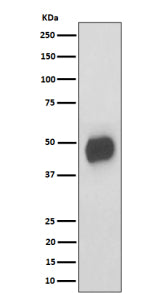
BSG antibody detects basigin, also known as CD147, an immunoglobulin superfamily member encoded by the BSG gene. Basigin is a transmembrane glycoprotein expressed in many tissues and cell types. It functions as a receptor and regulator of matrix metalloproteinases, monocarboxylate transporters, and extracellular signaling molecules. By modulating these pathways, basigin influences immune responses, metabolism, and tumor progression.<br><br>BSG antibody is widely used in immunology, oncology, and infectious disease research. In cancer, basigin promotes tumor invasion and metastasis by inducing matrix metalloproteinase activity. It also regulates metabolic processes by facilitating lactate transport through interactions with monocarboxylate transporters. By detecting basigin, researchers can study how CD147 contributes to the tumor microenvironment and cellular metabolism.<br><br>The antibody is suitable for western blotting, flow cytometry, immunohistochemistry, and immunofluorescence. In western blot assays, BSG antibody detects protein bands corresponding to basigin in multiple tissues. Flow cytometry enables quantitative assessment of CD147 expression on immune and tumor cells. Immunohistochemistry reveals tissue specific patterns, while immunofluorescence highlights subcellular localization at plasma membranes.<br><br>Basigin also plays roles in immunity and infectious disease. It regulates leukocyte activation, T cell function, and pathogen interactions. Basigin has been identified as a receptor for certain parasites and viruses, linking it to infectious disease research. By using BSG antibody, scientists can evaluate the role of CD147 in host pathogen interactions and immune regulation.<br><br>BSG antibody from NSJ Bioreagents provides strong specificity for detecting basigin in cancer, immunity, and metabolism. Its proven reliability across techniques ensures accurate results for both basic and translational studies.
Specifications
| Family | Primary antibody |
|---|---|
| Formulation | Rabbit IgG in phosphate buffered saline, pH 7.4, 150mM NaCl, 0.02% sodium azide and 50% glycerol, 0.4-0.5mg/ml BSA |
| Format | Liquid |
| Clone | 30B80 |
| Host Animal | Rabbit |
| Clonality | Recombinant Rabbit Monoclonal |
| Isotype | Rabbit IgG |
| Species Reactivity | Mouse |
| Application | WB, IHC, ICC, IF, IP |
| Application Details | Western blot: 1:500-1:2000,Immunohistochemistry: 1:50-1:200,Immunocytochemistry/Immunofluorescence: 1:50-1:200,Immunoprecipitation: 1:50 |
| Application Note | Optimal dilution of the Bsg antibody should be determined by the researcher. |
| Immunogen | A synthesized peptide derived from human CD147 was used as the immunogen for the Bsg antibody. |
| Buffer | Rabbit IgG in phosphate buffered saline, pH 7.4, 150mM NaCl, 0.02% sodium azide and 50% glycerol, 0.4-0.5mg/ml BSA. |
| Purity | Affinity-chromatography |
| Storage | Store the Bsg antibody at -20oC. |
| Limitation | This Bsg antibody is available for research use only. |
| Uniprot # | P18572 |
| Status | Available |
| PDF Link | http://www.nsjbio.com/tds-pdf/bsg-antibody-cd147-fy12532-nsj-bioreagents |
| Title | Bsg Antibody / CD147 |
| Description | BSG antibody detects basigin, also known as CD147, an immunoglobulin superfamily member encoded by the BSG gene. Basigin is a transmembrane glycoprotein expressed in many tissues and cell types. It functions as a receptor and regulator of matrix metalloproteinases, monocarboxylate transporters, and extracellular signaling molecules. By modulating these pathways, basigin influences immune responses, metabolism, and tumor progression.<br><br>BSG antibody is widely used in immunology, oncology, and infectious disease research. In cancer, basigin promotes tumor invasion and metastasis by inducing matrix metalloproteinase activity. It also regulates metabolic processes by facilitating lactate transport through interactions with monocarboxylate transporters. By detecting basigin, researchers can study how CD147 contributes to the tumor microenvironment and cellular metabolism.<br><br>The antibody is suitable for western blotting, flow cytometry, immunohistochemistry, and immunofluorescence. In western blot assays, BSG antibody detects protein bands corresponding to basigin in multiple tissues. Flow cytometry enables quantitative assessment of CD147 expression on immune and tumor cells. Immunohistochemistry reveals tissue specific patterns, while immunofluorescence highlights subcellular localization at plasma membranes.<br><br>Basigin also plays roles in immunity and infectious disease. It regulates leukocyte activation, T cell function, and pathogen interactions. Basigin has been identified as a receptor for certain parasites and viruses, linking it to infectious disease research. By using BSG antibody, scientists can evaluate the role of CD147 in host pathogen interactions and immune regulation.<br><br>BSG antibody from NSJ Bioreagents provides strong specificity for detecting basigin in cancer, immunity, and metabolism. Its proven reliability across techniques ensures accurate results for both basic and translational studies. |
Share