NSJ Bioreagents
SKU:F54099-0.05ML
Beta Catenin Antibody (C-Terminal Region)
Beta Catenin Antibody (C-Terminal Region)
Couldn't load pickup availability
Beta Catenin / CTNNB1 is a key downstream component of the canonical Wnt signaling pathway. In the absence of Wnt, forms a complex with AXIN1, AXIN2, APC, CSNK1A1 and GSK3B that promotes phosphorylation on N-terminal Ser and Thr residues and ubiquitination of CTNNB1 via BTRC and its subsequent degradation by the proteasome. In the presence of Wnt ligand, CTNNB1 is not ubiquitinated and accumulates in the nucleus, where it acts as a coactivator for transcription factors of the TCF/LEF family, leading to activate Wnt responsive genes. Involved in the regulation of cell adhesion. Acts as a negative regulator of centrosome cohesion. Involved in the CDK2/PTPN6/CTNNB1/CEACAM1 pathway of insulin internalization. Blocks anoikis of malignant kidney and intestinal epithelial cells and promotes their anchorage-independent growth by down-regulating DAPK2. Disrupts PML function and PML-NB formation by inhibiting RANBP2-mediated sumoylation of PML (PubMed:<a href=http://www.uniprot.org/citations/17524503 target=_blank>17524503</a>, PubMed:<a href=http://www.uniprot.org/citations/18077326 target=_blank>18077326</a>, PubMed:<a href=http://www.uniprot.org/citations/18086858 target=_blank>18086858</a>, PubMed:<a href=http://www.uniprot.org/citations/18957423 target=_blank>18957423</a>, PubMed:<a href=http://www.uniprot.org/citations/21262353 target=_blank>21262353</a>, PubMed:<a href=http://www.uniprot.org/citations/22647378 target=_blank>22647378</a>, PubMed:<a href=http://www.uniprot.org/citations/22699938 target=_blank>22699938</a>, PubMed:<a href=http://www.uniprot.org/citations/22155184 target=_blank>22155184</a>). Promotes neurogenesis by maintaining sympathetic neuroblasts within the cell cycle (By similarity). [UniProt]
Specifications
| Family | Primary antibody |
|---|---|
| Formulation | In 1X PBS, pH 7.4, with 0.09% sodium azide |
| Format | Purified |
| Clone | 691CT11.2.1 |
| Host Animal | Mouse |
| Clonality | Monoclonal (mouse origin) |
| Isotype | Mouse IgG1 |
| Species Reactivity | Human, Mouse, Rat, Monkey |
| Predicted Species Reactivity | Bovine |
| Application | WB |
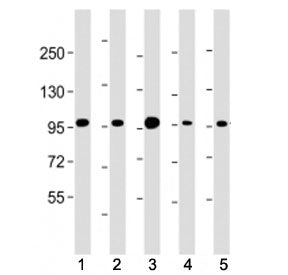
| Application Details | Western blot: 1:4000 |
| Application Note | The stated application concentrations are suggested starting points. Titration of the Beta Catenin antibody may be required due to differences in protocols and secondary/substrate sensitivity. |
| Immunogen | A portion of amino acids 687-721 from human Beta Catenin was used as the immunogen for the Beta Catenin antibody. |
| Purity | Protein G purified |
| Storage | Aliquot the Beta Catenin antibody and store frozen at -20oC or colder. Avoid repeated freeze-thaw cycles. |
| Limitation | This Beta Catenin antibody is available for research use only. |
| Uniprot # | P35222 |
| Status | Available |
| PDF Link | https://www.nsjbio.com/tds-pdf/beta-catenin-antibody-c-terminal-region-691ct1121-f54099 |
| Title | Beta Catenin Antibody (C-Terminal Region) |
| Description | Beta Catenin / CTNNB1 is a key downstream component of the canonical Wnt signaling pathway. In the absence of Wnt, forms a complex with AXIN1, AXIN2, APC, CSNK1A1 and GSK3B that promotes phosphorylation on N-terminal Ser and Thr residues and ubiquitination of CTNNB1 via BTRC and its subsequent degradation by the proteasome. In the presence of Wnt ligand, CTNNB1 is not ubiquitinated and accumulates in the nucleus, where it acts as a coactivator for transcription factors of the TCF/LEF family, leading to activate Wnt responsive genes. Involved in the regulation of cell adhesion. Acts as a negative regulator of centrosome cohesion. Involved in the CDK2/PTPN6/CTNNB1/CEACAM1 pathway of insulin internalization. Blocks anoikis of malignant kidney and intestinal epithelial cells and promotes their anchorage-independent growth by down-regulating DAPK2. Disrupts PML function and PML-NB formation by inhibiting RANBP2-mediated sumoylation of PML (PubMed:<a href=http://www.uniprot.org/citations/17524503 target=_blank>17524503</a>, PubMed:<a href=http://www.uniprot.org/citations/18077326 target=_blank>18077326</a>, PubMed:<a href=http://www.uniprot.org/citations/18086858 target=_blank>18086858</a>, PubMed:<a href=http://www.uniprot.org/citations/18957423 target=_blank>18957423</a>, PubMed:<a href=http://www.uniprot.org/citations/21262353 target=_blank>21262353</a>, PubMed:<a href=http://www.uniprot.org/citations/22647378 target=_blank>22647378</a>, PubMed:<a href=http://www.uniprot.org/citations/22699938 target=_blank>22699938</a>, PubMed:<a href=http://www.uniprot.org/citations/22155184 target=_blank>22155184</a>). Promotes neurogenesis by maintaining sympathetic neuroblasts within the cell cycle (By similarity). [UniProt] |
Share