NSJ Bioreagents
SKU:F41872-0.08ML
Axin-1 Antibody
Axin-1 Antibody
Couldn't load pickup availability
Axin-1 is a cytoplasmic protein which contains a regulation of G-protein signaling (RGS) domain and a dishevelled and axin (DIX) domain. The encoded protein interacts with adenomatosis polyposis coli, catenin beta-1, glycogen synthase kinase 3 beta, protein phosphate 2, and itself. This protein functions as a negative regulator of the wingless-type MMTV integration site family, member 1 (WNT) signaling pathway and can induce apoptosis. The crystal structure of a portion of this protein, alone and in a complex with other proteins, has been resolved. Mutations in this gene have been associated with hepatocellular carcinoma, hepatoblastomas, ovarian endometriod adenocarcinomas, and medullablastomas. Two transcript variants encoding distinct isoforms have been identified for the gene.
Specifications
| Family | Primary antibody |
|---|---|
| Formulation | In 1X PBS, pH 7.4, with 0.09% sodium azide |
| Format | Antigen affinity purified |
| Host Animal | Rabbit |
| Clonality | Polyclonal (rabbit origin) |
| Isotype | Rabbit Ig |
| Species Reactivity | Human |
| Application | WB, IHC, ELISA |
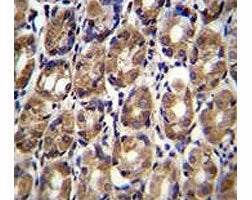
| Application Details | Western blot: 1:1000,IHC (Paraffin): 1:10-1:50 |
| Application Note | Titration of the Axin-1 antibody may be required due to differences in protocols and secondary/substrate sensitivity. |
| Immunogen | A portion of amino acids 710-738 from the human protein was used as the immunogen for this Axin-1 antibody. |
| Purity | Antigen affinity |
| Storage | Aliquot the Axin-1 antibody and store frozen at -20oC or colder. Avoid repeated freeze-thaw cycles. |
| Limitation | This Axin-1 antibody is available for research use only. |
| Uniprot # | O15169 |
| Status | Available |
| PDF Link | https://www.nsjbio.com/tds-pdf/axin-1-antibody-f41872 |
| Title | Axin-1 Antibody |
| Description | Axin-1 is a cytoplasmic protein which contains a regulation of G-protein signaling (RGS) domain and a dishevelled and axin (DIX) domain. The encoded protein interacts with adenomatosis polyposis coli, catenin beta-1, glycogen synthase kinase 3 beta, protein phosphate 2, and itself. This protein functions as a negative regulator of the wingless-type MMTV integration site family, member 1 (WNT) signaling pathway and can induce apoptosis. The crystal structure of a portion of this protein, alone and in a complex with other proteins, has been resolved. Mutations in this gene have been associated with hepatocellular carcinoma, hepatoblastomas, ovarian endometriod adenocarcinomas, and medullablastomas. Two transcript variants encoding distinct isoforms have been identified for the gene. |
Share