NSJ Bioreagents
SKU:F47082-0.08ML
ASIC3 Antibody / ACCN3
ASIC3 Antibody / ACCN3
Couldn't load pickup availability
This gene encodes a member of the degenerin/epithelial sodium channel (DEG/ENaC) superfamily. The members of this family are amiloride-sensitive sodium channels that contain intracellular N and C termini, two hydrophobic transmembrane regions, and a large extracellular loop, which has many cysteine residues with conserved spacing. The member encoded by this gene is an acid sensor and may play an important role in the detection of lasting pH changes. In addition, a heteromeric association between this member and ACCN1/ASIC2 has been observed as proton-gated channels sensitive to gadolinium. Alternative splicing of this gene generates three transcript variants encoding distinct isoforms.
Specifications
| Family | Primary antibody |
|---|---|
| Formulation | In 1X PBS, pH 7.4, with 0.09% sodium azide |
| Format | Antigen affinity purified |
| Host Animal | Rabbit |
| Clonality | Polyclonal (rabbit origin) |
| Isotype | Rabbit Ig |
| Species Reactivity | Human |
| Application | WB, ELISA |
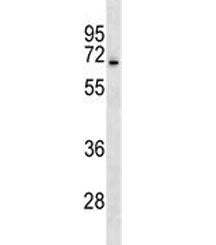
| Application Details | Western blot: 1:1000 |
| Application Note | Titration of the ASIC3 antibody may be required due to differences in protocols and secondary/substrate sensitivity. |
| Immunogen | A portion of amino acids 55-83 from the human protein was used as the immunogen for this ASIC3 antibody. |
| Purity | Antigen affinity |
| Storage | Aliquot the ASIC3 antibody and store frozen at -20oC or colder. Avoid repeated freeze-thaw cycles. |
| Limitation | This ASIC3 antibody is available for research use only. |
| Uniprot # | Q9UHC3 |
| Status | Available |
| PDF Link | https://www.nsjbio.com/tds-pdf/asic3-antibody-accn3-f47082 |
| Title | ASIC3 Antibody / ACCN3 |
| Description | This gene encodes a member of the degenerin/epithelial sodium channel (DEG/ENaC) superfamily. The members of this family are amiloride-sensitive sodium channels that contain intracellular N and C termini, two hydrophobic transmembrane regions, and a large extracellular loop, which has many cysteine residues with conserved spacing. The member encoded by this gene is an acid sensor and may play an important role in the detection of lasting pH changes. In addition, a heteromeric association between this member and ACCN1/ASIC2 has been observed as proton-gated channels sensitive to gadolinium. Alternative splicing of this gene generates three transcript variants encoding distinct isoforms. |
Share