NSJ Bioreagents
SKU:F46228-0.08ML
APG7 Antibody
APG7 Antibody
Couldn't load pickup availability
Macroautophagy is the major inducible pathway for the general turnover of cytoplasmic constituents in eukaryotic cells, it is also responsible for the degradation of active cytoplasmic enzymes and organelles during nutrient starvation. Macroautophagy involves the formation of double-membrane bound autophagosomes which enclose the cytoplasmic constituent targeted for degradation in a membrane bound structure, which then fuse with the lysosome (or vacuole) releasing a single-membrane bound autophagic bodies which are then degraded within the lysosome (or vacuole). APG7 functions as an E1 enzyme essential for multisubstrates such as GABARAPL1 and ATG12. APG3L is an E2-like conjugating enzyme facilitating covalent binding of APG8 (MAP1LC3) to phosphatidylethanolamine (PE). APG7 (an E1-like enzyme) facilitates this reaction by forming an E1-E2 complex with APG3. Formation of the PE conjugate is essential for autophagy.
Specifications
| Family | Primary antibody |
|---|---|
| Formulation | In 1X PBS, pH 7.4, with 0.09% sodium azide |
| Format | Purified |
| Host Animal | Rabbit |
| Clonality | Polyclonal (rabbit origin) |
| Isotype | Rabbit Ig |
| Species Reactivity | Human, Mouse |
| Predicted Species Reactivity | Chicken, Rat |
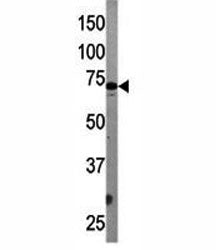
| Application | WB, IHC, ELISA |
| Application Details | Western blot: 1:1000,IHC (Paraffin): 1:50-1:100 |
| Application Note | Titration of the APG7 antibody may be required due to differences in protocols and secondary/substrate sensitivity. |
| Immunogen | A portion of amino acids 284-313 from the human protein was used as the immunogen for this APG7 antibody. |
| Purity | Purified |
| Storage | Aliquot the APG7 antibody and store frozen at -20oC or colder. Avoid repeated freeze-thaw cycles. |
| Limitation | This APG7 antibody is available for research use only. |
| Uniprot # | O95352 |
| Status | Available |
| PDF Link | https://www.nsjbio.com/tds-pdf/apg7-antibody-f46228 |
| Title | APG7 Antibody |
| Description | Macroautophagy is the major inducible pathway for the general turnover of cytoplasmic constituents in eukaryotic cells, it is also responsible for the degradation of active cytoplasmic enzymes and organelles during nutrient starvation. Macroautophagy involves the formation of double-membrane bound autophagosomes which enclose the cytoplasmic constituent targeted for degradation in a membrane bound structure, which then fuse with the lysosome (or vacuole) releasing a single-membrane bound autophagic bodies which are then degraded within the lysosome (or vacuole). APG7 functions as an E1 enzyme essential for multisubstrates such as GABARAPL1 and ATG12. APG3L is an E2-like conjugating enzyme facilitating covalent binding of APG8 (MAP1LC3) to phosphatidylethanolamine (PE). APG7 (an E1-like enzyme) facilitates this reaction by forming an E1-E2 complex with APG3. Formation of the PE conjugate is essential for autophagy. |
Share