1
/
of
1
NSJ Bioreagents
SKU:R32509
APC2 Antibody
APC2 Antibody
Regular price
$449.00 USD
Regular price
Sale price
$449.00 USD
Unit price
/
per
Shipping calculated at checkout.
Couldn't load pickup availability
APC2, also called APCL or Adenomatous polyposis coli protein-like, is a deduced 2,303-amino acid protein that contains an N-terminal coiled-coil domain, followed by an armadillo domain and five 20-amino acid repeats. The human APC2 gene is mapped to chromosome 19p13.3. It is found that the 20-amino acid repeat domain of APCL could bind beta-catenin (CTNNB1) and deplete the intracellular beta-catenin pool. A reporter gene assay revealed that APCL could regulate interaction of beta-catenin with T cell-specific transcription factors (TCF7), although less efficiently than APC.
Specifications
| Family | Primary antibody |
|---|---|
| Formulation | 0.5mg/ml if reconstituted with 0.2ml sterile DI water |
| Format | Antigen affinity purified |
| Host Animal | Rabbit |
| Clonality | Polyclonal (rabbit origin) |
| Isotype | Rabbit IgG |
| Species Reactivity | Human |
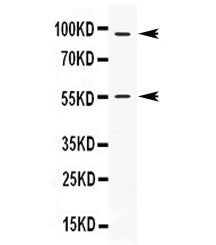
| Application | WB |
| Application Details | Western blot: 0.5-1ug/ml |
| Application Note | Differences in protocols and secondary/substrate sensitivity may require the APC2 antibody to be titrated for optimal performance. |
| Immunogen | Amino acids 51-90 (KHLQGKLEQEARVLVSSGQTEVLEQLKALQMDITSLYNLK) from the human protein were used as the immunogen for the APC2 antibody. |
| Buffer | Lyophilized from 1X PBS with 2.5% BSA and 0.025% sodium azide |
| Purity | Antigen affinity |
| Storage | After reconstitution, the APC2 antibody can be stored for up to one month at 4oC. For long-term, aliquot and store at -20oC. Avoid repeated freezing and thawing. |
| Limitation | This APC2 antibody is available for research use only. |
| Uniprot # | O95996 |
| Status | Available |
| PDF Link | https://www.nsjbio.com/tds-pdf/apc2-antibody-r32509 |
| Title | APC2 Antibody |
| Description | APC2, also called APCL or Adenomatous polyposis coli protein-like, is a deduced 2,303-amino acid protein that contains an N-terminal coiled-coil domain, followed by an armadillo domain and five 20-amino acid repeats. The human APC2 gene is mapped to chromosome 19p13.3. It is found that the 20-amino acid repeat domain of APCL could bind beta-catenin (CTNNB1) and deplete the intracellular beta-catenin pool. A reporter gene assay revealed that APCL could regulate interaction of beta-catenin with T cell-specific transcription factors (TCF7), although less efficiently than APC. |
Share