1
/
of
1
NSJ Bioreagents
SKU:RQ7129
ANXA3 Antibody / Annexin A3
ANXA3 Antibody / Annexin A3
Regular price
$449.00 USD
Regular price
Sale price
$449.00 USD
Unit price
/
per
Shipping calculated at checkout.
Couldn't load pickup availability
Annexin A3 is a protein that in humans is encoded by the ANXA3 gene. It is abnormally expressed in fetuses of both IVF and ICSI, which may contribute to the increase risk of birth defects in these ART. This gene encodes a member of the annexin family. Members of this calcium-dependent phospholipid-binding protein family play a role in the regulation of cellular growth and in signal transduction pathways. This protein functions in the inhibition of phospholipase A2 and cleavage of inositol 1,2-cyclic phosphate to form inositol 1-phosphate. This protein may also play a role in anti-coagulation.
Specifications
| Family | Primary antibody |
|---|---|
| Formulation | 0.5mg/ml if reconstituted with 0.2ml sterile DI water |
| Format | Antigen affinity purified |
| Clone | 2H3H8 |
| Host Animal | Mouse |
| Clonality | Monoclonal (mouse origin) |
| Isotype | Mouse IgG2b |
| Species Reactivity | Human |
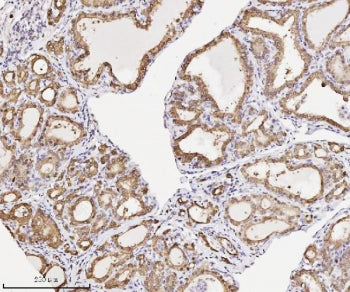
| Application | WB, IHC-P, FACS |
| Application Details | Western blot: 0.5-1ug/ml,Immunohistochemistry (FFPE): 2-5ug/ml,Flow cytometry: 1-3ug/million cells |
| Application Note | Optimal dilution of the ANXA3 antibody should be determined by the researcher. |
| Localization | Cytoplasmic, membranous |
| Immunogen | Amino acids RKALLTLADGRRDESLKVDEHLAKQDAQILYK were used as the immunogen for the ANXA3 antibody. |
| Buffer | Lyophilized from 1X PBS with 2% Trehalose |
| Purity | Antigen affinity purified |
| Storage | After reconstitution, the ANXA3 antibody can be stored for up to one month at 4oC. For long-term, aliquot and store at -20oC. Avoid repeated freezing and thawing. |
| Limitation | This ANXA3 antibody is available for research use only. |
| Uniprot # | P12429 |
| Status | Available |
| PDF Link | https://www.nsjbio.com/tds-pdf/anxa3-antibody-annexin-a3-2h3h8-rq7129 |
| Title | ANXA3 Antibody / Annexin A3 |
| Description | Annexin A3 is a protein that in humans is encoded by the ANXA3 gene. It is abnormally expressed in fetuses of both IVF and ICSI, which may contribute to the increase risk of birth defects in these ART. This gene encodes a member of the annexin family. Members of this calcium-dependent phospholipid-binding protein family play a role in the regulation of cellular growth and in signal transduction pathways. This protein functions in the inhibition of phospholipase A2 and cleavage of inositol 1,2-cyclic phosphate to form inositol 1-phosphate. This protein may also play a role in anti-coagulation. |
Share