1
/
of
1
NSJ Bioreagents
SKU:F40418-0.08ML
Anti-Src Antibody
Anti-Src Antibody
Regular price
$205.00 USD
Regular price
Sale price
$205.00 USD
Unit price
/
per
Shipping calculated at checkout.
Couldn't load pickup availability
This gene is highly similar to the v-src gene of Rous sarcoma virus. This proto-oncogene may play a role in the regulation of embryonic development and cell growth. The protein encoded by this gene is a tyrosine-protein kinase whose activity can be inhibited by phosphorylation by c-Src kinase. Mutations in this gene could be involved in the malignant progression of colon cancer. Two transcript variants encoding the same protein have been found for this gene.
Specifications
| Family | Primary antibody |
|---|---|
| Formulation | In 1X PBS, pH 7.4, with 0.09% sodium azide |
| Format | Purified |
| Clone | 17AT28 |
| Host Animal | Mouse |
| Clonality | Monoclonal (mouse origin) |
| Isotype | Mouse IgG1 |
| Species Reactivity | Human, Mouse |
| Application | WB, IF, ELISA |
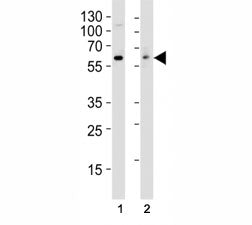
| Application Details | Immunofluorescence: 1:10-1:50,Western blot: 1:100-1000 |
| Application Note | Titration of the anti-Src antibody may be required due to differences in protocols and secondary/substrate sensitivity. |
| Immunogen | This anti-Src antibody was produced from a mouse immunized with a full length recombinant human protein. |
| Purity | Purified |
| Storage | Aliquot the anti-Src antibody and store frozen at -20oC or colder. Avoid repeated freeze-thaw cycles. |
| Limitation | This anti-Src antibody is available for research use only. |
| Uniprot # | P12931 |
| Status | Available |
| PDF Link | https://www.nsjbio.com/tds-pdf/anti-src-antibody-17at28-f40418 |
| Title | Anti-Src Antibody |
| Description | This gene is highly similar to the v-src gene of Rous sarcoma virus. This proto-oncogene may play a role in the regulation of embryonic development and cell growth. The protein encoded by this gene is a tyrosine-protein kinase whose activity can be inhibited by phosphorylation by c-Src kinase. Mutations in this gene could be involved in the malignant progression of colon cancer. Two transcript variants encoding the same protein have been found for this gene. |
Share