NSJ Bioreagents
SKU:F48167-0.08ML
Anti-LGR5 Antibody
Anti-LGR5 Antibody
Couldn't load pickup availability
LGR5/GPR49 is a receptor for R-spondins that potentiates the canonical Wnt signaling pathway and acts as a stem cell marker of the intestinal epithelium and the hair follicle. Upon binding to R-spondins (RSPO1, RSPO2, RSPO3 or RSPO4), associates with phosphorylated LRP6 and frizzled receptors that are activated by extracellular Wnt receptors, triggering the canonical Wnt signaling pathway to increase expression of target genes. In contrast to classical G-protein coupled receptors, does not activate heterotrimeric G-proteins to transduce the signal. Involved in the development and/or maintenance of the adult intestinal stem cells during postembryonic development. [UniProt]
Specifications
| Family | Primary antibody |
|---|---|
| Formulation | In 1X PBS, pH 7.4, with 0.09% sodium azide |
| Format | Purified |
| Host Animal | Rabbit |
| Clonality | Polyclonal (rabbit origin) |
| Isotype | Rabbit Ig |
| Species Reactivity | Human |
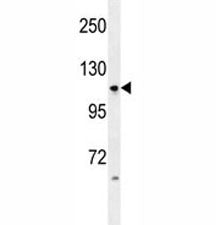
| Application | IHC, WB, ELISA |
| Application Details | IHC (Paraffin): 1:10-1:50,Western blot: 1:1000 |
| Application Note | Titration of the anti-LGR5 antibody may be required due to differences in protocols and secondary/substrate sensitivity. |
| Immunogen | A portion of amino acids 605-638 from the human protein was used as the immunogen for this anti-LGR5 antibody. |
| Purity | Purified |
| Storage | Aliquot the anti-LGR5 antibody and store frozen at -20oC or colder. Avoid repeated freeze-thaw cycles. |
| Limitation | This anti-LGR5 antibody is available for research use only. |
| Uniprot # | O75473 |
| Status | Available |
| PDF Link | https://www.nsjbio.com/tds-pdf/anti-lgr5-antibody-f48167 |
| Title | Anti-LGR5 Antibody |
| Description | LGR5/GPR49 is a receptor for R-spondins that potentiates the canonical Wnt signaling pathway and acts as a stem cell marker of the intestinal epithelium and the hair follicle. Upon binding to R-spondins (RSPO1, RSPO2, RSPO3 or RSPO4), associates with phosphorylated LRP6 and frizzled receptors that are activated by extracellular Wnt receptors, triggering the canonical Wnt signaling pathway to increase expression of target genes. In contrast to classical G-protein coupled receptors, does not activate heterotrimeric G-proteins to transduce the signal. Involved in the development and/or maintenance of the adult intestinal stem cells during postembryonic development. [UniProt] |
Share