1
/
of
1
NSJ Bioreagents
SKU:F43166-0.08ML
Anti-APP Antibody
Anti-APP Antibody
Regular price
$205.00 USD
Regular price
Sale price
$205.00 USD
Unit price
/
per
Shipping calculated at checkout.
Couldn't load pickup availability
The APP gene encodes Amyloid beta, a cell surface receptor and transmembrane precursor protein that is cleaved by secretases to form a number of peptides. Some of these peptides are secreted and can bind to the acetyltransferase complex APBB1/TIP60 to promote transcriptional activation, while others form the protein basis of the amyloid plaques found in the brains of patients with Alzheimer disease. Mutations in this gene have been implicated in autosomal dominant Alzheimer disease and cerebroarterial amyloidosis (cerebral amyloid angiopathy). Multiple transcript variants encoding several different isoforms have been found for this gene.
Specifications
| Family | Primary antibody |
|---|---|
| Formulation | In 1X PBS, pH 7.4, with 0.09% sodium azide |
| Format | Antigen affinity purified |
| Host Animal | Rabbit |
| Clonality | Polyclonal (rabbit origin) |
| Isotype | Rabbit Ig |
| Species Reactivity | Human |
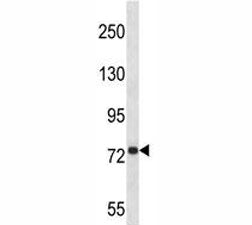
| Application | IF, IHC, WB, ELISA |
| Application Details | Western blot: 1:1000,Immunofluorescence: 1:10-1:50,IHC (Paraffin): 1:10-1:50 |
| Application Note | Titration of the anti-APP antibody may be required due to differences in protocols and secondary/substrate sensitivity. |
| Immunogen | A portion of amino acids 333-362 from the human protein was used as the immunogen for this anti-APP antibody. |
| Purity | Antigen affinity |
| Storage | Aliquot the anti-APP antibody and store frozen at -20oC or colder. Avoid repeated freeze-thaw cycles. |
| Limitation | This anti-APP antibody is available for research use only. |
| Uniprot # | P05067 |
| Status | Available |
| PDF Link | https://www.nsjbio.com/tds-pdf/anti-app-antibody-f43166 |
| Title | Anti-APP Antibody |
| Description | The APP gene encodes Amyloid beta, a cell surface receptor and transmembrane precursor protein that is cleaved by secretases to form a number of peptides. Some of these peptides are secreted and can bind to the acetyltransferase complex APBB1/TIP60 to promote transcriptional activation, while others form the protein basis of the amyloid plaques found in the brains of patients with Alzheimer disease. Mutations in this gene have been implicated in autosomal dominant Alzheimer disease and cerebroarterial amyloidosis (cerebral amyloid angiopathy). Multiple transcript variants encoding several different isoforms have been found for this gene. |
Share