1
/
of
1
NSJ Bioreagents
SKU:F53806-0.05ML
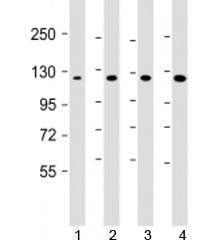
AIP1 Antibody / DAB2IP
AIP1 Antibody / DAB2IP
Regular price
$205.00 USD
Regular price
Sale price
$205.00 USD
Unit price
/
per
Shipping calculated at checkout.
Couldn't load pickup availability
ASK-interacting protein 1 functions as a scaffold protein implicated in the regulation of a large spectrum of both general and specialized signaling pathways. Involved in several processes such as innate immune response, inflammation and cell growth inhibition, apoptosis, cell survival, angiogenesis, cell migration and maturation. Plays also a role in cell cycle checkpoint control; reduces G1 phase cyclin levels resulting in G0/G1 cell cycle arrest. [UniProt]
Specifications
| Family | Primary antibody |
|---|---|
| Formulation | In 1X PBS, pH 7.4, with 0.09% sodium azide |
| Format | Purified |
| Clone | 1626CT702.263.21 |
| Host Animal | Mouse |
| Clonality | Monoclonal (mouse origin) |
| Isotype | Mouse IgG2a, kappa |
| Species Reactivity | Human, Mouse |
| Application | WB |
| Application Details | Western blot: 1:500-1000 |
| Application Note | Titration of the AIP1 antibody may be required due to differences in protocols and substrate sensitivity. |
| Immunogen | Human recombinant protein corresponding to amino acids 782-1038 was used as the immunogen for this AIP1 antibody. |
| Purity | Protein G affinity chromatography |
| Storage | Aliquot the AIP1 antibody and store frozen at -20oC or colder. Avoid repeated freeze-thaw cycles. |
| Limitation | This AIP1 antibody is available for research use only. |
| Uniprot # | Q5VWQ8 |
| Status | Available |
| PDF Link | https://www.nsjbio.com/tds-pdf/aip1-antibody-dab2ip-1626ct70226321-f53806 |
| Title | AIP1 Antibody / DAB2IP |
| Description | ASK-interacting protein 1 functions as a scaffold protein implicated in the regulation of a large spectrum of both general and specialized signaling pathways. Involved in several processes such as innate immune response, inflammation and cell growth inhibition, apoptosis, cell survival, angiogenesis, cell migration and maturation. Plays also a role in cell cycle checkpoint control; reduces G1 phase cyclin levels resulting in G0/G1 cell cycle arrest. [UniProt] |
Share