NSJ Bioreagents
SKU:FY12538
AER61 Antibody / EOGT
AER61 Antibody / EOGT
Couldn't load pickup availability
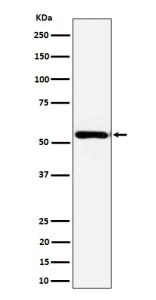
EOGT antibody detects EGF domain specific O linked N acetylglucosamine transferase, an enzyme encoded by the EOGT gene. EOGT catalyzes the addition of O GlcNAc moieties to EGF like domains of secreted and membrane proteins, modifying signaling molecules and receptors. This post translational modification regulates ligand receptor interactions and signaling pathways critical for development and homeostasis.<br><br>EOGT antibody is widely used in studies of glycosylation, signaling, and developmental biology. By detecting EOGT, researchers can explore how O GlcNAc modification influences Notch signaling, growth factor binding, and tissue morphogenesis. Mutations in EOGT are associated with Adams Oliver syndrome, a developmental disorder characterized by limb and scalp defects, underscoring its biological importance.<br><br> In western blot assays, EOGT antibody detects protein bands corresponding to the enzyme in tissue and cell extracts. Immunohistochemistry maps expression in developing tissues, while immunofluorescence reveals subcellular localization consistent with endoplasmic reticulum and Golgi compartments. These methods support detailed analysis of glycosyltransferase biology.<br><br>EOGT mediated O GlcNAc modification contributes to signaling regulation in vascular and neural development. Dysregulation of this pathway has implications in congenital disorders, cancer, and immune regulation. By applying EOGT antibody, scientists can investigate how defects in protein glycosylation contribute to human disease and identify therapeutic strategies that target glycosylation pathways.<br><br>EOGT antibody from NSJ Bioreagents provides strong specificity for studying glycosylation and developmental biology. Its performance across multiple assays makes it a valuable reagent for exploring the role of O GlcNAc transferases in health and disease.
Specifications
| Family | Primary antibody |
|---|---|
| Formulation | Rabbit IgG in phosphate buffered saline, pH 7.4, 150mM NaCl, 0.02% sodium azide and 50% glycerol, 0.4-0.5mg/ml BSA |
| Format | Liquid |
| Clone | 30E02 |
| Host Animal | Rabbit |
| Clonality | Recombinant Rabbit Monoclonal |
| Isotype | Rabbit IgG |
| Species Reactivity | Human, Mouse, Rat |
| Application | WB |
| Application Details | Western blot: 1:500-1:2000 |
| Application Note | Optimal dilution of the EOGT antibody should be determined by the researcher. |
| Immunogen | A synthesized peptide derived from human AER61 was used as the immunogen for the EOGT antibody. |
| Buffer | Rabbit IgG in phosphate buffered saline, pH 7.4, 150mM NaCl, 0.02% sodium azide and 50% glycerol, 0.4-0.5mg/ml BSA. |
| Purity | Affinity-chromatography |
| Storage | Store the EOGT antibody at -20oC. |
| Limitation | This EOGT antibody is available for research use only. |
| Uniprot # | Q5NDL2 |
| Status | Available |
| PDF Link | http://www.nsjbio.com/tds-pdf/eogt-antibody-aer61-fy12538-nsj-bioreagents |
| Title | AER61 Antibody / EOGT |
| Description | EOGT antibody detects EGF domain specific O linked N acetylglucosamine transferase, an enzyme encoded by the EOGT gene. EOGT catalyzes the addition of O GlcNAc moieties to EGF like domains of secreted and membrane proteins, modifying signaling molecules and receptors. This post translational modification regulates ligand receptor interactions and signaling pathways critical for development and homeostasis.<br><br>EOGT antibody is widely used in studies of glycosylation, signaling, and developmental biology. By detecting EOGT, researchers can explore how O GlcNAc modification influences Notch signaling, growth factor binding, and tissue morphogenesis. Mutations in EOGT are associated with Adams Oliver syndrome, a developmental disorder characterized by limb and scalp defects, underscoring its biological importance.<br><br> In western blot assays, EOGT antibody detects protein bands corresponding to the enzyme in tissue and cell extracts. Immunohistochemistry maps expression in developing tissues, while immunofluorescence reveals subcellular localization consistent with endoplasmic reticulum and Golgi compartments. These methods support detailed analysis of glycosyltransferase biology.<br><br>EOGT mediated O GlcNAc modification contributes to signaling regulation in vascular and neural development. Dysregulation of this pathway has implications in congenital disorders, cancer, and immune regulation. By applying EOGT antibody, scientists can investigate how defects in protein glycosylation contribute to human disease and identify therapeutic strategies that target glycosylation pathways.<br><br>EOGT antibody from NSJ Bioreagents provides strong specificity for studying glycosylation and developmental biology. Its performance across multiple assays makes it a valuable reagent for exploring the role of O GlcNAc transferases in health and disease. |
Share