1
/
of
1
NSJ Bioreagents
SKU:RQ6402
ABIN-1 Antibody / TNIP1
ABIN-1 Antibody / TNIP1
Regular price
$449.00 USD
Regular price
Sale price
$449.00 USD
Unit price
/
per
Shipping calculated at checkout.
Couldn't load pickup availability
TNFAIP3-interacting protein 1, also called ABIN-1 or A20-binding inhibitor of NF-kappa-B activation 1, is a protein that in humans is encoded by the TNIP1 gene. This gene encodes an A20-binding protein which plays a role in autoimmunity and tissue homeostasis through the regulation of nuclear factor kappa-B activation. Mutations in this gene have been associated with psoriatic arthritis, rheumatoid arthritis, and systemic lupus erythematosus. Multiple transcript variants encoding different isoforms have been found for this gene.
Specifications
| Family | Primary antibody |
|---|---|
| Formulation | 0.5mg/ml if reconstituted with 0.2ml sterile DI water |
| Format | Purified |
| Host Animal | Rabbit |
| Clonality | Polyclonal (rabbit origin) |
| Isotype | Rabbit IgG |
| Species Reactivity | Human, Mouse, Rat |
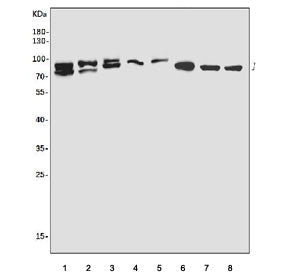
| Application | WB, Direct ELISA |
| Application Details | Western blot: 0.5-1ug/ml,Direct ELISA: 0.1-0.5ug/ml |
| Application Note | Optimal dilution of the ABIN-1 antibody should be determined by the researcher. |
| Localization | Cytoplasmic, nuclear |
| Immunogen | Recombinant human protein (amino acids E312-K371) was used as the immunogen for the ABIN-1 antibody. |
| Buffer | Lyophilized from 1X PBS with 2% Trehalose |
| Purity | Antigen affinity purified |
| Storage | After reconstitution, the ABIN-1 antibody can be stored for up to one month at 4oC. For long-term, aliquot and store at -20oC. Avoid repeated freezing and thawing. |
| Limitation | This ABIN-1 antibody is available for research use only. |
| Uniprot # | Q15025 |
| Status | Available |
| PDF Link | https://www.nsjbio.com/tds-pdf/abin-1-antibody-tnip1-rq6402 |
| Title | ABIN-1 Antibody / TNIP1 |
| Description | TNFAIP3-interacting protein 1, also called ABIN-1 or A20-binding inhibitor of NF-kappa-B activation 1, is a protein that in humans is encoded by the TNIP1 gene. This gene encodes an A20-binding protein which plays a role in autoimmunity and tissue homeostasis through the regulation of nuclear factor kappa-B activation. Mutations in this gene have been associated with psoriatic arthritis, rheumatoid arthritis, and systemic lupus erythematosus. Multiple transcript variants encoding different isoforms have been found for this gene. |
Share