1
/
of
1
NSJ Bioreagents
SKU:F42410-0.08ML
ABCG4 Antibody
ABCG4 Antibody
Regular price
$205.00 USD
Regular price
Sale price
$205.00 USD
Unit price
/
per
Shipping calculated at checkout.
Couldn't load pickup availability
The protein encoded by this gene is included in the superfamily of ATP-binding cassette (ABC) transporters. ABC proteins transport various molecules across extra- and intra-cellular membranes. ABC genes are divided into seven distinct subfamilies (ABC1, MDR/TAP, MRP, ALD, OABP, GCN20, White). This protein is a member of the White subfamily and is expressed predominantly in liver tissue. The function has not yet been determined but may involve cholesterol transport. Alternate splice variants have been described but their full length sequences have not been determined.
Specifications
| Family | Primary antibody |
|---|---|
| Formulation | In 1X PBS, pH 7.4, with 0.09% sodium azide |
| Format | Antigen affinity purified |
| Host Animal | Rabbit |
| Clonality | Polyclonal (rabbit origin) |
| Isotype | Rabbit Ig |
| Species Reactivity | Human |
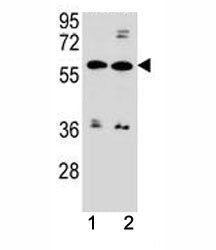
| Application | WB, ELISA |
| Application Details | Western blot: 1:1000 |
| Application Note | Titration of the ABCG4 antibody may be required due to differences in protocols and secondary/substrate sensitivity. |
| Immunogen | A portion of amino acids 36-65 from the human protein was used as the immunogen for this ABCG4 antibody. |
| Purity | Antigen affinity |
| Storage | Aliquot the ABCG4 antibody and store frozen at -20oC or colder. Avoid repeated freeze-thaw cycles. |
| Limitation | This ABCG4 antibody is available for research use only. |
| Uniprot # | Q9H172 |
| Status | Available |
| PDF Link | https://www.nsjbio.com/tds-pdf/abcg4-antibody-f42410 |
| Title | ABCG4 Antibody |
| Description | The protein encoded by this gene is included in the superfamily of ATP-binding cassette (ABC) transporters. ABC proteins transport various molecules across extra- and intra-cellular membranes. ABC genes are divided into seven distinct subfamilies (ABC1, MDR/TAP, MRP, ALD, OABP, GCN20, White). This protein is a member of the White subfamily and is expressed predominantly in liver tissue. The function has not yet been determined but may involve cholesterol transport. Alternate splice variants have been described but their full length sequences have not been determined. |
Share