Cloud-clone
SKU:MAB367Hu22
Monoclonal Antibody to Vascular Endothelial Growth Factor Receptor 2 (VEGFR2)
Monoclonal Antibody to Vascular Endothelial Growth Factor Receptor 2 (VEGFR2)
Couldn't load pickup availability
;Immunohistochemistry: 5-20µg/mL;
;Immunocytochemistry: 5-20µg/mL;
;Optimal working dilutions must be determined by end user.
Product No.
MAB367Hu22
Organism Species
Homo sapiens (Human)
Source
Monoclonal antibody preparation
Host
Mouse
Potency (Clone Number)
C5
Ig Isotype
IgG2a Kappa
Purification
Protein A + Protein G affinity chromatography
Label
None
Immunogen
EPB367Hu61-Eukaryotic Vascular Endothelial Growth Factor Receptor 2 (VEGFR2)
Buffer Formulation
0.01M PBS, pH7.4, containing 0.05% Proclin-300, 50% glycerol.
Traits
Liquid
Concentration
1mg/ml
Organism Species More
Mus musculus (Mouse), Rattus norvegicus (Rat)
Applications
WB; IHC; ICC; IP.
If the antibody is used in flow cytometry, please check FCM antibodies.
UOM
20µl 100µl 200µl 1ml 10ml
SPECIFITY
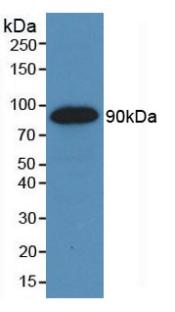
The antibody is a mouse monoclonal antibody raised against VEGFR2. It has been selected for its ability to recognize VEGFR2 in immunohistochemical staining and western blotting.
USAGE
Western blotting: 0.5-2µg/mL;
Immunohistochemistry: 5-20µg/mL;
Immunocytochemistry: 5-20µg/mL;
Optimal working dilutions must be determined by end user.
STORAGE
Store at 4°C for frequent use. Stored at -20°C in a manual defrost freezer for two year without detectable loss of activity. Avoid repeated freeze-thaw cycles.
STABILITY
The thermal stability is described by the loss rate. The loss rate was determined by accelerated thermal degradation test, that is, incubate the protein at 37°C for 48h, and no obvious degradation and precipitation were observed. The loss rate is less than 5% within the expiration date under appropriate storage condition.
| Magazine | Citations |
| APMIS | Peritumoral brain edema in angiomatous supratentorial meningiomas: an investigation of the vascular endothelial growth factor A pathway PubMed: 23398358 |
| Acta Biomater | Antioxidant and bone repair properties of quercetin-functionalized hydroxyapatite: an in vitro osteoblast-osteoclast-endothelial cell co-culture study PubMed: 26689470 |
| Acta Biomaterialia | Antioxidant and bone repair properties of quercetin-functionalized hydroxyapatite: An in vitro osteoblast–osteoclast–endothelial cell co-culture study Pubmed:26689470 |
| Journal of Cellular Physiology | A Human 3D In Vitro Model to Assess the Relationship Between Osteoporosis and Disseminationto Bone of Breast Cancer Tumor Cells. pubmed:27925188 |
| Regenerative Biomaterials | The directional migration and differentiation of mesenchymal stem cells toward vascular endothelial cells stimulated by biphasic calcium phosphate ceramic 10.1093/rb/rbx028 |
| International Journal of Immunopathology and Pharmacology | VEGF-R2 and TNF-R1 expression and cytokine production by samples of mammary adenocarcinomas and correlations with histopathological parameters of these … Pubmed:29985074 |
| JOURNAL OF DERMATOLOGICAL TREATMENT | Effect of isotretinoin (13-cis-retinoic acid) on levels of soluble VEGF receptors (sVEGFR1, sVEGFR2, sVEGFR3) in patients with acne vulgaris Pubmed: 32043381 |
| Journal of Genetic Engineering and Biotechnology | Encapsulated VEGF 121-PLA microparticles promote angiogenesis in human endometrium stromal cells 33523322 |
| Mol Cell Biochem | Intuitive repositioning of an anti-depressant drug in combination with tivozanib: precision medicine for breast cancer therapy 34324118 |
| BMC Nephrol | Effect of subacute poisoning with lambdacyhalothrin on vascular endothelial growth factor 2 receptor in mice kidneys Pubmed:35643467 |
Share