Cloud-clone
SKU:PAB623Mu02
Polyclonal Antibody to Surfactant Protein C (SP-C)
Polyclonal Antibody to Surfactant Protein C (SP-C)
Couldn't load pickup availability
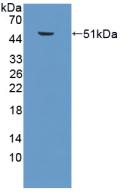
Western blotting: 0.5-2µg/mL;
Immunohistochemistry: 5-20µg/mL;
Immunocytochemistry: 5-20µg/mL;
Optimal working dilutions must be determined by end user.
Product No.
PAB623Mu02
Organism Species
Mus musculus (Mouse).
Source
Polyclonal antibody preparation
Host
Rabbit
Potency
n/a
Ig Type
IgG
Purification
Antigen-specific affinity chromatography followed by Protein A affinity chromatography
Label
None
Immunogen
RPB623Mu02-Recombinant Surfactant Protein C (SP-C)
Buffer Formulation
0.01M PBS, pH7.4, containing 0.05% Proclin-300, 50% glycerol.
Traits
Liquid
Concentration
500µg/mL
Organism Species More
Rattus norvegicus (Rat)
Applications
WB; IHC; ICC; IP.
If the antibody is used in flow cytometry, please check FCM antibodies.
UOM
20µl 100µl 200µl 1ml 10ml
SPECIFITY
The antibody is a rabbit polyclonal antibody raised against SP-C. It has been selected for its ability to recognize SP-C in immunohistochemical staining and western blotting.
USAGE
Western blotting: 0.5-2µg/mL;
Immunohistochemistry: 5-20µg/mL;
Immunocytochemistry: 5-20µg/mL;
Optimal working dilutions must be determined by end user.
STORAGE
Store at 4°C for frequent use. Stored at -20°C in a manual defrost freezer for two year without detectable loss of activity. Avoid repeated freeze-thaw cycles.
STABILITY
The thermal stability is described by the loss rate. The loss rate was determined by accelerated thermal degradation test, that is, incubate the protein at 37°C for 48h, and no obvious degradation and precipitation were observed. The loss rate is less than 5% within the expiration date under appropriate storage condition.
| Magazine | Citations |
| American Journal of Rhinology & Allergy | Detection of surfactant proteins A, B, C, and D in human nasal mucosa and their regulation in chronic rhinosinusitis with polyps PubMed: 23406594 |
| Plos one | Staphylococcus aureus and Pseudomonas aeruginosa Express and Secrete Human Surfactant Proteins PubMed: PMC3551896 |
| Plos one | The Detection of Surfactant Proteins A, B, C and D in the Human Brain and Their Regulation in Cerebral Infarction, Autoimmune Conditions and Infections of the CNS PubMed: PMC3787032 |
| Nachweis und Charakterisierung des Oberfl?chenproteins PLUNC (Palate, Lung and Nasal Clone Protein) an der Augenoberfl?che und Bedeutung für das Trockene Auge Opus4:Source | |
| Mol Cell Biochem | Autophagy regulates hyperoxia-induced intracellular accumulation of surfactant protein C in alveolar type II cells PubMed: 26122393 |
| Plos One | Serum Levels of Surfactant Proteins in Patients with Combined Pulmonary Fibrosis and Emphysema (CPFE) Pubmed:27337142 |
| PLoS One | The Cerebral Surfactant System and Its Alteration in HydrocephalicConditions. pubmed:27656877 |
| Frontiers in Aging Neuroscience | Correlations of Ventricular Enlargement with Rheologically Active SurfactantProteins in Cerebrospinal Fluid. pubmed:28101052 |
| Frontiers in Aging Neuroscience | Correlations of Ventricular Enlargement with Rheologically Active Surfactant Proteins in Cerebrospinal Fluid PMC5209370 |
| American Journal of Physiology. Lung Cellular and Molecular Physiology | Chronic lung injury and impaired pulmonary function in a mouse model of acid ceramidase deficiency. pubmed:29167126 |
| Respiratory research | Effects and molecular mechanisms of intrauterine infection/inflammation on lung development Pubmed:29747649 |
| Lung | Serum Surfactant Protein Levels in Patients Admitted to the Hospital with Acute COPD Exacerbation Pubmed:29445934 |
| Molecular Neurobiology | Rheologically Essential Surfactant Proteins of the CSF Interacting with Periventricular White Matter Changes in Hydrocephalus Patients–Implications for CSF … Doi: 10.1007/s12035-019-01648-z |
| Stem Cells International | Adipose Tissue-Derived Stem Cells Have the Ability to Differentiate into Alveolar Epithelial Cells and Ameliorate Lung Injury Caused by Elastase-Induced Emphysema … |
| Stem Cells International | Efficient Differentiation of Mouse Induced Pluripotent Stem Cells into Alveolar Epithelium Type II with a BRD4 Inhibitor Pubmed: 31949433 |
| Catalog No. | Related products for research use of Mus musculus (Mouse) Organism species | Applications (RESEARCH USE ONLY!) |
| APB623Mu01 | Active Surfactant Protein C (SP-C) | Cell culture; Activity Assays. |
| RPB623Mu01 | Recombinant Surfactant Protein C (SP-C) | Positive Control; Immunogen; SDS-PAGE; WB. |
| RPB623Mu02 | Recombinant Surfactant Protein C (SP-C) | Positive Control; Immunogen; SDS-PAGE; WB. |
| PAB623Mu01 | Polyclonal Antibody to Surfactant Protein C (SP-C) | WB; IHC; ICC; IP. |
| PAB623Mu02 | Polyclonal Antibody to Surfactant Protein C (SP-C) | WB; IHC; ICC; IP. |
| SEB623Mu | ELISA Kit for Surfactant Protein C (SP-C) | Enzyme-linked immunosorbent assay for Antigen Detection. |
| LMB623Mu | Magnetic Luminex Assay Kit for Surfactant Protein C (SP-C) ,etc. | Magnetic Luminex Assay for Antigen Detection. |
Share