Cloud-clone
SKU:SCA860Hu
CLIA Kit for Epithelial Neutrophil Activating Peptide 78 (ENA78)
CLIA Kit for Epithelial Neutrophil Activating Peptide 78 (ENA78)
Couldn't load pickup availability
Chemiluminescent immunoassay for Antigen Detection.
Product No.
SCA860Hu
Organism Species
Homo sapiens (Human).
Sample Type
Serum, plasma and other biological fluids
Test Method
Double-antibody Sandwich
Assay Length
2h, 40min
Detection Range
1.37-1,000pg/mL
Sensitivity
The minimum detectable dose of this kit is typically less than 0.59pg/mL.
UOM
48T 96T 96T*5 96T*10 96T*100
Specificity
This assay has high sensitivity and excellent specificity for detection of Epithelial Neutrophil Activating Peptide 78 (ENA78).
No significant cross-reactivity or interference between Epithelial Neutrophil Activating Peptide 78 (ENA78) and analogues was observed.
Recovery
Matrices listed below were spiked with certain level of recombinant Epithelial Neutrophil Activating Peptide 78 (ENA78) and the recovery rates were calculated by comparing the measured value to the expected amount of Epithelial Neutrophil Activating Peptide 78 (ENA78) in samples.
| Matrix | Recovery range (%) | Average(%) |
| serum(n=5) | 82-96 | 92 |
| EDTA plasma(n=5) | 78-103 | 87 |
| heparin plasma(n=5) | 81-98 | 86 |
Precision
Intra-assay Precision (Precision within an assay): 3 samples with low, middle and high level Epithelial Neutrophil Activating Peptide 78 (ENA78) were tested 20 times on one plate, respectively.
Inter-assay Precision (Precision between assays): 3 samples with low, middle and high level Epithelial Neutrophil Activating Peptide 78 (ENA78) were tested on 3 different plates, 8 replicates in each plate.
CV(%) = SD/meanX100
Intra-Assay: CV<10%
Inter-Assay: CV<12%
Linearity
The linearity of the kit was assayed by testing samples spiked with appropriate concentration of Epithelial Neutrophil Activating Peptide 78 (ENA78) and their serial dilutions. The results were demonstrated by the percentage of calculated concentration to the expected.
| Sample | 1:2 | 1:4 | 1:8 | 1:16 |
| serum(n=5) | 85-95% | 84-93% | 81-95% | 78-105% |
| EDTA plasma(n=5) | 83-98% | 92-101% | 91-98% | 97-105% |
| heparin plasma(n=5) | 91-103% | 95-103% | 91-104% | 87-97% |
Stability
The stability of kit is determined by the loss rate of activity. The loss rate of this kit is less than 5% within the expiration date under appropriate storage condition.
To minimize extra influence on the performance, operation procedures and lab conditions, especially room temperature, air humidity, incubator temperature should be strictly controlled. It is also strongly suggested that the whole assay is performed by the same operator from the beginning to the end.
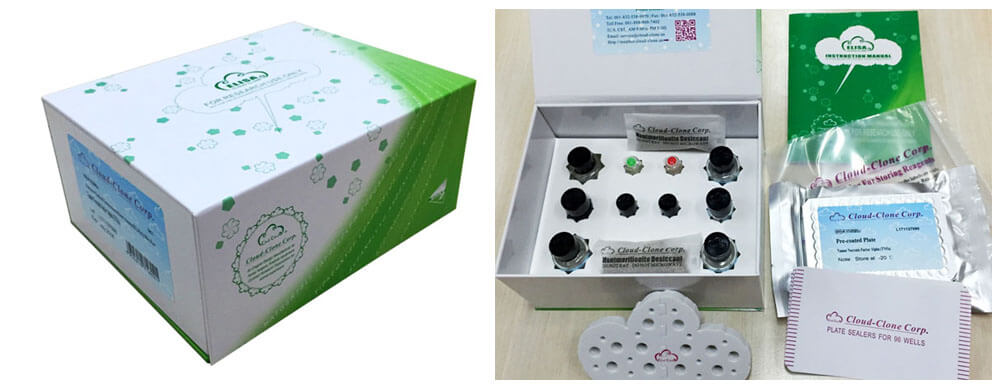
Reagents and materials provided
| Reagents | Quantity | Reagents | Quantity |
| Pre-coated, ready to use 96-well strip plate | 1 | Plate sealer for 96 wells | 4 |
| Standard | 2 | Standard Diluent | 1×20mL |
| Detection Reagent A | 1×120µL | Assay Diluent A | 1×12mL |
| Detection Reagent B | 1×120µL | Assay Diluent B | 1×12mL |
| Substrate A | 1×10mL | Substrate B | 1×2mL |
| Wash Buffer (30 × concentrate) | 1×20mL | Instruction manual | 1 |
Assay procedure summary
1. Prepare all reagents, samples and standards;
2. Add 100µL standard or sample to each well. Incubate 1 hours at 37°C;
3. Aspirate and add 100µL prepared Detection Reagent A. Incubate 1 hour at 37°C;
4. Aspirate and wash 3 times;
5. Add 100µL prepared Detection Reagent B. Incubate 30 minutes at 37°C;
6. Aspirate and wash 5 times;
7. Add 100µL Substrate Solution. Incubate 10 minutes at 37°C;
8. Read RLU value immediately.
| Magazine | Citations |
| Journal of Biochemical and Molecular Toxicology | Ameliorative Effects of Curcumin on Fibrinogen-Like Protein-2 Gene Expression, Some Oxido-Inflammatory and Apoptotic Markers in a Rat Model of l-Arginine-Induced Acute Pancreatitis. Pubmed:26862043 |
| Journal of Biochemical and Molecular Toxicology | Ameliorative Effects of Curcumin on Fibrinogen-Like Protein-2 Gene Expression, Some Oxido-Inflammatory and Apoptotic Markers in a Rat Model of l-Arginine-Induced Acute Pancreatitis pubmed:26862043 |
| OncoTargets and Therapy | The clinical significance of CXCL5 in non-small cell lung cancer. pubmed:29200871 |
| Biochimie | Activated CXCL5-CXCR2 axis promotes the migration, invasion and EMT of papillary thyroid carcinoma cells via modulation of β-catenin pathway Pubmed:29471001 |
| Cancer Biology & Therapy | Activation of CXCL5-CXCR2 axis promotes proliferation and accelerates G1 to S phase transition of papillary thyroid carcinoma cells and activates JNK and p38 … Pubmed: 30404567 |
| Respiratory Research | Phospholipase Cε plays a crucial role in neutrophilic inflammation accompanying acute lung injury through augmentation of CXC chemokine production from … Pubmed: 30634975 |
| American Journal of Pathology | Interleukin17–CXCR2 axis facilitates breast cancer progression by up-regulating neutrophil recruitment Pubmed: 31654638 |
| Bioactive Materials | Secretions from hypochlorous acid-treated tumor cells delivered in a melittin hydrogel potentiate cancer immunotherapy 34820587 |
| Am J Cancer Res | Differential expression profile of CXC-receptor-2 ligands as potential biomarkers in pancreatic ductal adenocarcinoma Pubmed:35141005 |
Share