

Cloud-clone
SKU:APB280Hu61
Active Cathepsin D (CTSD)
Active Cathepsin D (CTSD)
Couldn't load pickup availability
Product No.
APB280Hu61
Organism Species
Homo sapiens (Human).
Buffer Formulation
PBS, pH7.4, containing 0.01% SKL, 1mM DTT, 5% Trehalose and Proclin300.
Traits
Freeze-dried powder
Purity
> 97%
Isoelectric Point
6.1
Applications
Cell culture; Activity Assays.
UOM
10µg 50µg 200µg 1mg 5mg
ACTIVITY TEST
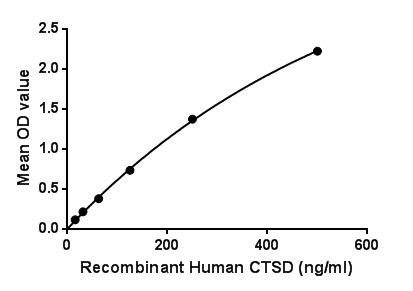
Figure. The binding activity of CTSD with HSP90b1.
Cathepsin D (CSTD) is an aspartic protease that depends critically on protonation of its active site Asp residue. Along with Asp-protonation, lower pH also leads to conformational switch in cathepsin-D: the N-terminal segment of the protease moves out of the active site as pH drops. Similar to other aspartic protainases, cathepsin D accommodates up to 8 amino acid residues in the binding cleft of the active site. The main physiological functions of cathepsin D consist of metabolic degradation of intracellular proteins, activation and degradation of polypeptide hormones and growth factors, activation of enzymatic precursors, processing of enzyme activators and inhibitors, brain antigen processing and regulation of programmed cell death. Besides, Heat Shock Protein 90kDa Beta 1 (HSP90b1) has been identified as an interactor of CSTD, thus a binding ELISA assay was conducted to detect the interaction of recombinant human CSTD and recombinant human HSP90b1. Briefly, CSTD were diluted serially in PBS, with 0.01% BSA (pH 7.4). Duplicate samples of 100μL were then transferred to HSP90b1-coated microtiter wells and incubated for 2h at 37℃. Wells were washed with PBST and incubated for 1h with anti-CSTD pAb, then aspirated and washed 3 times. After incubation with HRP labelled secondary antibody, wells were aspirated and washed 3 times. With the addition of substrate solution, wells were incubated 15-25 minutes at 37℃. Finally, add 50µL stop solution to the wells and read at 450nm immediately. The binding activity of CSTD and HSP90b1 was shown in Figure 1, and this effect was in a dose dependent manner.
USAGE
Reconstitute in 20mM Tris, 150mM NaCl (PH8.0) to a concentration of 0.1-1.0 mg/mL. Do not vortex.
STORAGE
Avoid repeated freeze/thaw cycles. Store at 2-8°C for one month. Aliquot and store at -80°C for 12 months.
STABILITY
The thermal stability is described by the loss rate. The loss rate was determined by accelerated thermal degradation test, that is, incubate the protein at 37°C for 48h, and no obvious degradation and precipitation were observed. The loss rate is less than 5% within the expiration date under appropriate storage condition.
| Magazine | Citations |
| Molecular Immunology | Cathepsin D is released after severe tissue trauma in vivo and is capable of generating C5a in vitro ScienceDirect: S0161589011008297 |
| 21 | Plasma Cathepsin D Levels: A Novel Tool to Predict Pediatric Hepatic Inflammation PubMed: 25732418 |
| Scientific Reportes | Plasma cathepsin D correlates with histological classifications of fatty liver disease in adults and responds to intervention pubmed:27922112 |
| Biomedicine & pharmacotherapy | Berberine ameliorates intrahippocampal kainate-induced status epilepticus and consequent epileptogenic process in the rat: Underlying mechanisms pubmed:28061403 |
| JGH OPEN | Limited applicability of cathepsin D for the diagnosis and monitoring of non‐alcoholic steatohepatitis |
| Diabetologia | Plasma cathepsin D activity is negatively associated with hepatic insulin sensitivity in overweight and obese humans Pubmed: 31690989 |
| Antioxidants | Iron and Advanced Glycation End Products: Emerging Role of Iron in Androgen Deficiency in Obesity Pubmed: 32235809 |
| Peptides | LVV-hemorphin-7 (LVV-H7) plays a role in antinociception in a rat model of alcohol-induced pain disorders 33253777 |
| Cells | Identification of Cathepsin D as a Plasma Biomarker for Alzheimer's Disease 33445607 |
| J Chem Neuroanat | Analysis of silymarin-modulating effects against acrylamide-induced cerebellar damage in male rats: Biochemical and pathological markers 33965515 |
| Front Cell Infect Microbiol | PGRS Domain of Rv0297 of Mycobacterium tuberculosis Is Involved in Modulation of Macrophage Functions to Favor Bacterial Persistence 33042856 |
| Nutr Metab Cardiovasc Dis | Serum CathepsinD in pregnancy: relation with metabolic and inflammatory markers and effects of fish oils and probiotics Pubmed:35304048 |
| Biosensors | A Comparison of Various Chips Used for the Manufacture of Biosensors Applied in Non-Fluidic Array SPRi, Based on the Example of Determination of Cathepsin D Pubmed:35049649 |
| Catalog No. | Related products for research use of Homo sapiens (Human) Organism species | Applications (RESEARCH USE ONLY!) |
| APB280Hu61 | Active Cathepsin D (CTSD) | Cell culture; Activity Assays. |
| EPB280Hu61 | Eukaryotic Cathepsin D (CTSD) | Positive Control; Immunogen; SDS-PAGE; WB. |
| RPB280Hu01 | Recombinant Cathepsin D (CTSD) | Positive Control; Immunogen; SDS-PAGE; WB. |
| EPB280Hu62 | Eukaryotic Cathepsin D (CTSD) | Positive Control; Immunogen; SDS-PAGE; WB. |
| RPB280Hu02 | Recombinant Cathepsin D (CTSD) | Positive Control; Immunogen; SDS-PAGE; WB. |
| RPB280Hu03 | Recombinant Cathepsin D (CTSD) | Positive Control; Immunogen; SDS-PAGE; WB. |
| RPB280Hu04 | Recombinant Cathepsin D (CTSD) | Positive Control; Immunogen; SDS-PAGE; WB. |
| PAB280Hu02 | Polyclonal Antibody to Cathepsin D (CTSD) | WB; IHC; ICC; IP. |
| PAB280Hu01 | Polyclonal Antibody to Cathepsin D (CTSD) | WB; IHC; ICC; IP. |
| LAB280Hu71 | Biotin-Linked Polyclonal Antibody to Cathepsin D (CTSD) | WB; IHC; ICC. |
| MAB280Hu21 | Monoclonal Antibody to Cathepsin D (CTSD) | WB; IHC; ICC; IP. |
| MAB280Hu26 | Monoclonal Antibody to Cathepsin D (CTSD) | WB; IHC; ICC; IP. |
| MAB280Hu22 | Monoclonal Antibody to Cathepsin D (CTSD) | WB; IHC; ICC; IP. |
| SEB280Hu | ELISA Kit for Cathepsin D (CTSD) | Enzyme-linked immunosorbent assay for Antigen Detection. |
| HEB280Hu | High Sensitive ELISA Kit for Cathepsin D (CTSD) | Enzyme-linked immunosorbent assay for Antigen Detection. |
| LMB280Hu | Magnetic Luminex Assay Kit for Cathepsin D (CTSD) ,etc. | Magnetic Luminex Assay for Antigen Detection. |
