Cloud-clone
SKU:APA030Hu01
Active Factor Related Apoptosis (FAS)
Active Factor Related Apoptosis (FAS)
Couldn't load pickup availability
Product No.
APA030Hu01
Organism Species
Homo sapiens (Human).
Buffer Formulation
20mM Tris, 150mM NaCl, pH8.0, containing 1mM EDTA, 1mM DTT, 0.01% SKL, 5% Trehalose and Proclin300.
Traits
Freeze-dried powder
Purity
> 95%
Isoelectric Point
6.7
Applications
Cell culture; Activity Assays.
UOM
10µg 50µg 200µg 1mg 5mg
ACTIVITY TEST
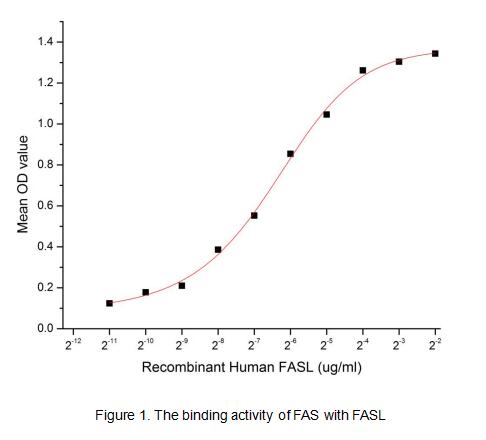
FAS (Tumor necrosis factor receptor superfamily member 6) belongs to the tumor necrosis factor receptor superfamily. FAS contains a death domain, which has been shown to play a central role in the physiological regulation of programmed cell death. A binding ELISA assay was conducted to detect the association of FAS with FASL. Briefly, FASL were diluted serially in PBS, with 0.01% BSA (pH 7.4). Duplicate samples of 100 ul FASL were then transferred to FAS-coated microtiter wells (1ug/ml, 100ul/well) and incubated for 1h at 37℃. Wells were washed with PBST and incubated for 1h with anti-FASL pAb, then aspirated and washed 3 times. After incubation with HRP labelled secondary antibody, wells were aspirated and washed 5 times. With the addition of substrate solution, wells were incubated 15-25 minutes at 37℃. Finally, add 50µL stop solution to the wells and read at 450nm immediately. The binding activity of FAS and FASL was shown in Figure 1, and this effect was in a dose dependent manner, the EC50 was approximately 0.012 ug/mL.
USAGE
Reconstitute in 20mM Tris, 150mM NaCl (PH8.0) to a concentration of 0.1-1.0 mg/mL. Do not vortex.
STORAGE
Avoid repeated freeze/thaw cycles. Store at 2-8°C for one month. Aliquot and store at -80°C for 12 months.
STABILITY
The thermal stability is described by the loss rate. The loss rate was determined by accelerated thermal degradation test, that is, incubate the protein at 37°C for 48h, and no obvious degradation and precipitation were observed. The loss rate is less than 5% within the expiration date under appropriate storage condition.
| Magazine | Citations |
| European Journal of Pharmacology | Montelukast abrogates rhabdomyolysis-induced acute renal failure via rectifying detrimental changes in antioxidant profile and systemic cytokines and apoptotic factors production ScienceDirect: S0014299912002580 |
| J Sci Food Agric. | Beneficial effects of Allium sativum L. stem extract on lipid metabolism and antioxidant status in obese mice fed a high fat diet Wiley: Source |
| Tumor Biology | The diplotype Fas? 1377A/? 670G as a genetic marker to predict a lower risk of breast cancer in Chinese women Springer:Source |
| Naunyn Schmiedebergs Arch Pharmacol | The multi-kinase inhibitor pazopanib targets hepatic stellate cell activation and apoptosis alleviating progression of liver fibrosis PubMed: 26269412 |
| Pharmacological Reports | The heat shock protein 90 inhibitor, 18-AAG, attenuates thioacetamide induced liver fibrosis in mice Science: Article |
| PLoS One | Aronia melanocarpa Extract Ameliorates Hepatic Lipid Metabolism through PPARγ2 Downregulation 10.1371 |
| Molecular Diagnosis & Therapy | The Utility of Biomarkers in Osteoporosis Management pubmed:28271451 |
| PLoS One | Aronia melanocarpa Extract Ameliorates Hepatic Lipid Metabolism through PPARγ2 Downregulation pubmed:28081181 |
| Journal of Microbiology, Immunology and Infection | Identification of a panel of serum protein markers in early stage of sepsis and its validation in a cohort of patients pubmed:28655573 |
| Journal of Functional Foods | Polysaccharides from Cyclocarya paliurus: Chemical composition and lipid-lowering effect on rats challenged with high-fat diet 10.1016/j.jff.2017.07.020 |
| Toxics | Zinc Oxide Nanoparticles Induced Oxidative DNA Damage, Inflammation and Apoptosis in Rat's Brain after Oral Exposure Pubmed:29861430 |
| Indian Journal of Medical and Paediatric Oncology | The correlation between the level of doxorubicin-induced cardiac damage and serum soluble Fas in an experimental rat model Doi: 10.4103/ijmpo.ijmpo_82_17 |
| Scientific Reports | EGF-mediated reduced miR-92a-1-5p controls HTR-8/SVneo cell invasion through activation of MAPK8 and FAS which in turn increase MMP-2/-9 expression Pubmed: 32703964 |