Cloud-clone
SKU:APB499Hu01
Active Tumor Necrosis Factor Receptor 1 (TNFR1)
Active Tumor Necrosis Factor Receptor 1 (TNFR1)
Couldn't load pickup availability
Product No.
APB499Hu01
Organism Species
Homo sapiens (Human).
Buffer Formulation
20mM Tris, 150mM NaCl, pH8.0, containing 1mM EDTA, 1mM DTT, 0.01% SKL, 5% Trehalose and Proclin300.
Traits
Freeze-dried powder
Purity
> 95%
Isoelectric Point
6.4
Applications
Cell culture; Activity Assays.
UOM
10µg 50µg 200µg 1mg 5mg
ACTIVITY TEST
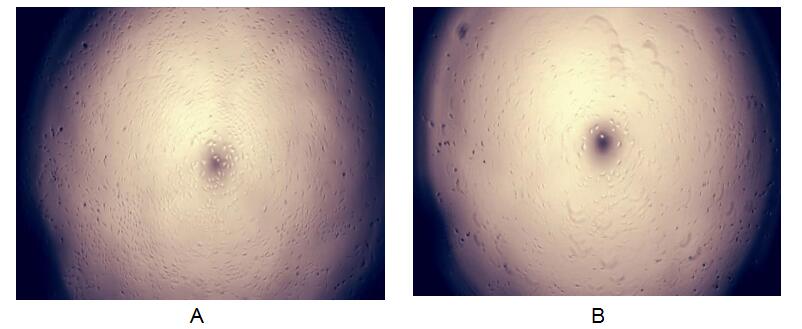
Figure. The apoptosis of A549 cells by TNFα was inhibited by TNFRSF1B.
Tumor necrosis factor receptor superfamily member 1B (TNFRSF1B), also known as tumor necrosis factor receptor 2 (TNFR2) and CD120b, is a membrane receptor that binds tumor necrosis factor-alpha (TNFα). This protein and TNF-receptor 1 form a heterocomplex that mediates the recruitment of two anti-apoptotic proteins, c-IAP1 and c-IAP2, which possess E3 ubiquitin ligase activity. TNFRSF1B can inhibit cell apoptosis which induced by TNFα. Briefly, A549 cells were seeded into triplicate wells of 96-well plates at a density of 2,000 cells/well and allowed to attach, replaced with serum-free overnight, then the medium was replaced with 2% serum standard DMEM including 1μg/mL TNFα and various concentrations of recombinant human TNFRSF1B. After incubated for 96h, cells were observed by inverted microscope and cell proliferation was measured by Cell Counting Kit-8 (CCK-8). Briefly, 10µL of CCK-8 solution was added to each well of the plate, then the absorbance at 450nm was measured using a microplate reader after incubating the plate at 37°C for 1-4 hours. Apoptosis of A549 cells had been inhibit after incubation with TNFRSF1B for 96h observed by inverted microscope was shown in Figure 1. Cell viability was assessed by CCK-8 (Cell Counting Kit-8) assay after incubation with recombinant TNFRSF1B for 96h. The result was shown in Figure 2. It was obvious that TNFRSF1B significantly suppress cell apoptosis induced by TNFα.
(A) A549 cells cultured in DMEM contain 1μg/mL TNFα and 0.1ng/mL TNFRSF1B for 96h;
(B) A549 cells cultured in DMEM only contain 1μg/mL TNFα for 96h.
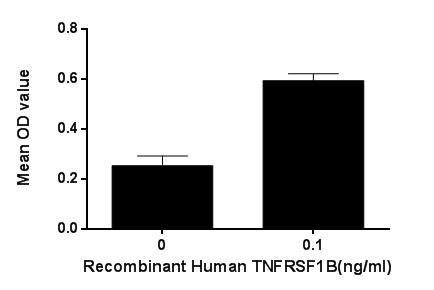
Figure. TNFRSF1B suppress the apoptosis of A549 cells induced by TNFα.
USAGE
Reconstitute in 20mM Tris, 150mM NaCl (PH8.0) to a concentration of 0.1-1.0 mg/mL. Do not vortex.
STORAGE
Avoid repeated freeze/thaw cycles. Store at 2-8°C for one month. Aliquot and store at -80°C for 12 months.
STABILITY
The thermal stability is described by the loss rate. The loss rate was determined by accelerated thermal degradation test, that is, incubate the protein at 37°C for 48h, and no obvious degradation and precipitation were observed. The loss rate is less than 5% within the expiration date under appropriate storage condition.
| Magazine | Citations |
| PLoS ONE | A Combinatorial Relative Mass Value Evaluation of Endogenous Bioactive Proteins in Three-Dimensional Cultured Nucleus Pulposus Cells of Herniated Intervertebral Discs: Identification of Potential Target Proteins for Gene Therapeutic Approaches Plosone: Source |
| Mediators of Inflammation | High Glucose Level Disturbs the Resveratrol-Evoked Curtailment of CX3CL1/CX3CR1 Signaling in Human Placental Circulation pubmed:28655972 |
| Annals of Neurology | High complement levels in astrocyte‐derived exosomes of Alzheimer disease Pubmed:29406582 |
| International Journal of Immunopathology and Pharmacology | VEGF-R2 and TNF-R1 expression and cytokine production by samples of mammary adenocarcinomas and correlations with histopathological parameters of these … Pubmed:29985074 |
| Cell Death & Disease | Inhibition of transmembrane TNF-α shedding by a specific antibody protects against septic shock Pubmed: 31383857 |
| Journal of Cardiovascular Translational Research | XPO1 Gene Therapy Attenuates Cardiac Dysfunction in Rats with Chronic Induced Myocardial Infarction Pubmed: 31768947 |
| Frontiers in Pharmacology | M10, a Myricetin-3-ObD-Lactose Sodium Salt, Prevents Ulcerative Colitis Through Inhibiting Necroptosis in Mice Pubmed: 33041798 |
| Catalog No. | Related products for research use of Homo sapiens (Human) Organism species | Applications (RESEARCH USE ONLY!) |
| APB499Hu02 | Active Tumor Necrosis Factor Receptor 1 (TNFR1) | Cell culture; Activity Assays. |
| RPB499Hu03 | Recombinant Tumor Necrosis Factor Receptor 1 (TNFR1) | Positive Control; Immunogen; SDS-PAGE; WB. |
| RPB499Hu01 | Recombinant Tumor Necrosis Factor Receptor 1 (TNFR1) | Positive Control; Immunogen; SDS-PAGE; WB. |
| APB499Hu01 | Active Tumor Necrosis Factor Receptor 1 (TNFR1) | Cell culture; Activity Assays. |
| RPB499Hu02 | Recombinant Tumor Necrosis Factor Receptor 1 (TNFR1) | Positive Control; Immunogen; SDS-PAGE; WB. |
| PAB499Hu01 | Polyclonal Antibody to Tumor Necrosis Factor Receptor 1 (TNFR1) | WB; IHC; ICC; IP. |
| PAB499Hu02 | Polyclonal Antibody to Tumor Necrosis Factor Receptor 1 (TNFR1) | WB,IHC |
| MAB499Hu21 | Monoclonal Antibody to Tumor Necrosis Factor Receptor 1 (TNFR1) | WB; IHC; ICC; IP. |
| MEB499Hu | Mini Samples ELISA Kit for Tumor Necrosis Factor Receptor 1 (TNFR1) | Enzyme-linked immunosorbent assay for Antigen Detection. |
| SEB499Hu | ELISA Kit for Tumor Necrosis Factor Receptor 1 (TNFR1) | Enzyme-linked immunosorbent assay for Antigen Detection. |
| LMB499Hu | Magnetic Luminex Assay Kit for Tumor Necrosis Factor Receptor 1 (TNFR1) ,etc. | Magnetic Luminex Assay for Antigen Detection. |